By Diane Wong
February 10th, 2026
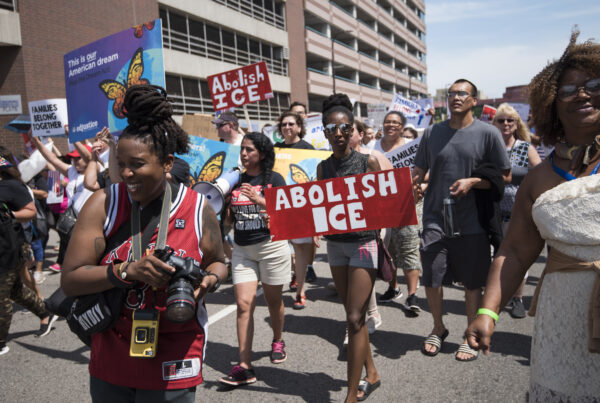
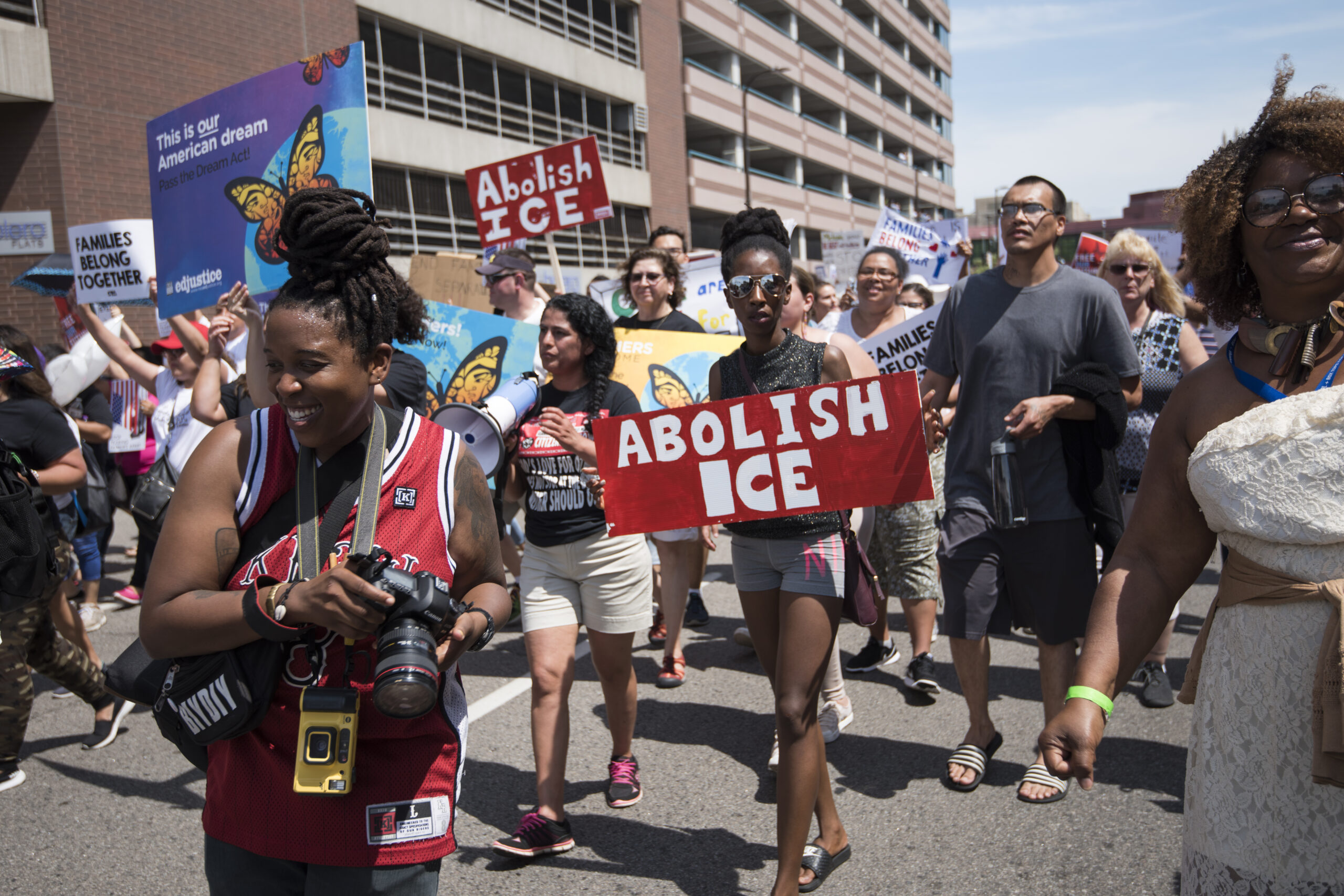
Over the past several weeks, Minneapolis has become a city under siege as federal immigration enforcement has dramatically expanded its presence in the region. The Department of Homeland Security has deployed thousands of federal agents to Minneapolis, including from Immigration and Customs Enforcement (ICE) and Customs and Border Protection, under what the agency has called the “largest immigration enforcement operation ever.” This escalation has coincided with the rapid spread of ‘ICE Out’ protests in Minneapolis and across the country, as communities mobilize against the growing militarization of immigration enforcement and the targeting of immigrant families.
Images and videos circulating online show heavily armed federal agents conducting raids on residential streets, often in unmarked vehicles and faces covered by masks. These tactics have produced a pervasive sense of fear, surveillance, and uncertainty, as residents report not knowing when or where enforcement agents will show up in neighborhoods or who will be targeted and disappeared. For many, the visibility of masked agents operating with military grade equipment and surveillance technologies has blurred the line between immigration enforcement and domestic occupation.
Tensions intensified in January of 2026 after ICE agents fatally shot 37-year-old Renée Nicole Good and 37-year-old Alex Pretti, Minneapolis residents and US citizens that sparked widespread protests. Public anger deepened as images of 5-year-old Liam Conejo Ramos taken into federal custody widely circulated online, Ramos being the fourth student from his Minneapolis neighborhood to be taken by immigration officers in recent weeks. In 2025, deaths in ICE custody reached the highest in two decades, with at least 32 people dying while detained under the agency’s authority. These deaths include 42-year-old Keith Porter who was shot by an off duty ICE officer in Northridge, California.
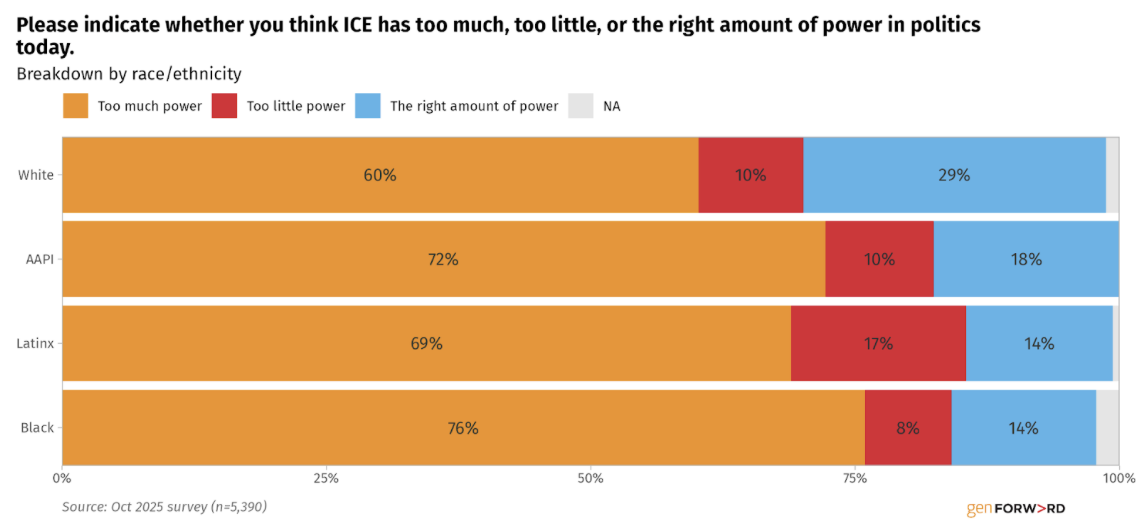
In October and November of 2025, GenForward in partnership with the Joyce Foundation fielded a survey exploring how young adults think about broad topics such as the ideals of good governance, the role of the state, their trust in institutions, and who has too much power in the country. One battery of questions focused on their attitudes related to ICE. According to the GenForward’s Good Governance Survey, young people express widespread concern about the power of federal agencies and the use of force by law enforcement. The data show that 76% of Black, 72% of AAPI, 69% of Latinx, and 60% of white respondents believe that ICE has too much power in politics today.
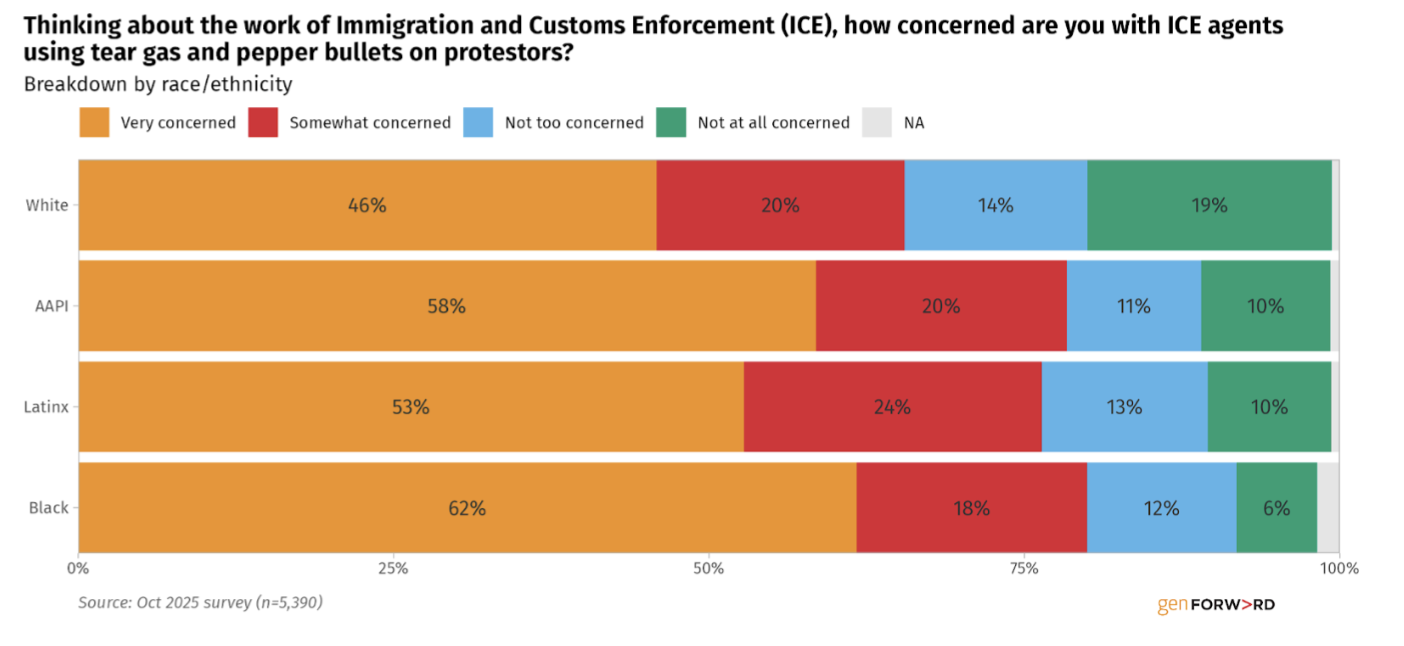
Many young adults also voiced concern about ICE’s use of force during public demonstrations. In fact, 62% of Black, 58% of AAPI, 53% of Latinx, and 46% of white respondents indicated that they were very concerned about ICE agents using tear gas and pepper bullets on protestors. Increasingly, federal agents have been seen using chemical weapons and tear gas in public spaces, including on residential blocks and near schools where children are present. Children are especially vulnerable to these exposures, which have been linked to chronic breathing problems, lasting eye damage, and psychological trauma, including PTSD.
The military expansion in U.S. cities has been bolstered by a dramatic increase in funding for the Department of Homeland and Security under the Trump administration. The massive budget bill passed by Congress last year nearly doubled the Homeland Security budget, allocating $191 billion over four years with $30 billion earmarked for ICE enforcement operations and $45 billion for expansion of immigrant detention facilities over the same period. The infusion of funding has aided the hiring of thousands of additional officers with sign-on bonuses of upwards to $50,000 and the building of new detention facilities in states like Colorado, New Hampshire, New Jersey, Texas, Georgia, and elsewhere. broadening of the agency’s operational footprint across the country. The funds have also accelerated the militarization of ICE by enabling the agency to acquire surveillance technologies, tactical equipment, armored vehicles, and weapons commonly associated with military operations.
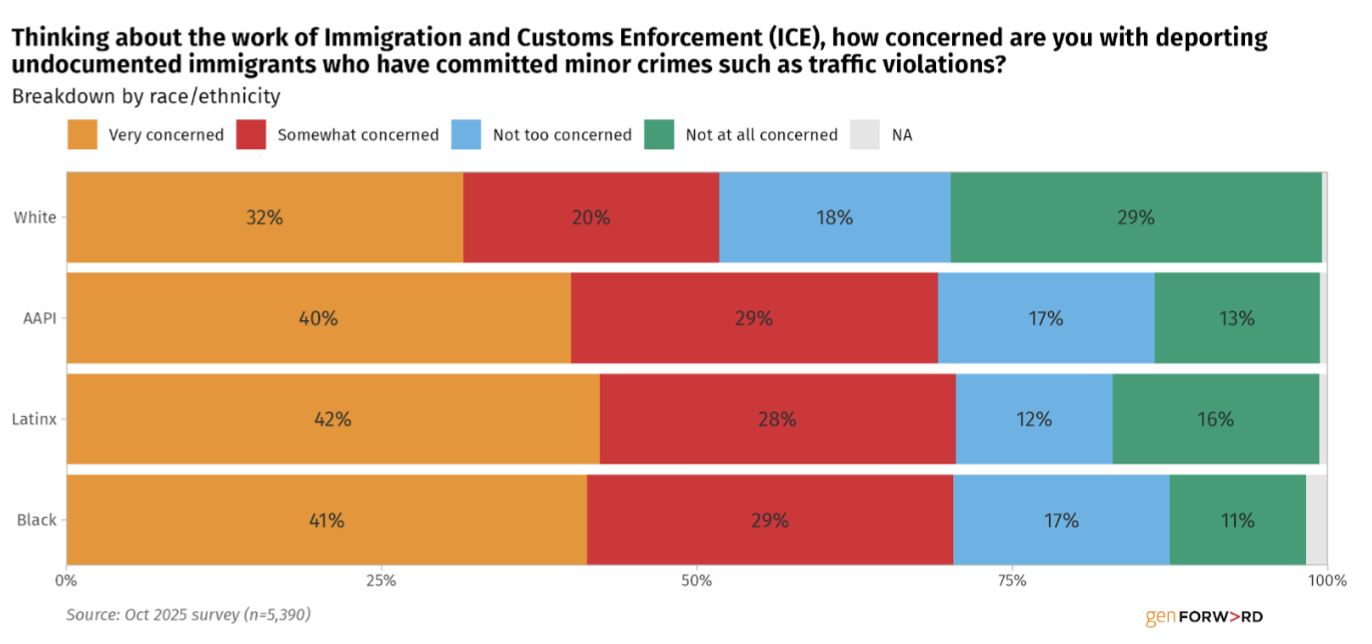
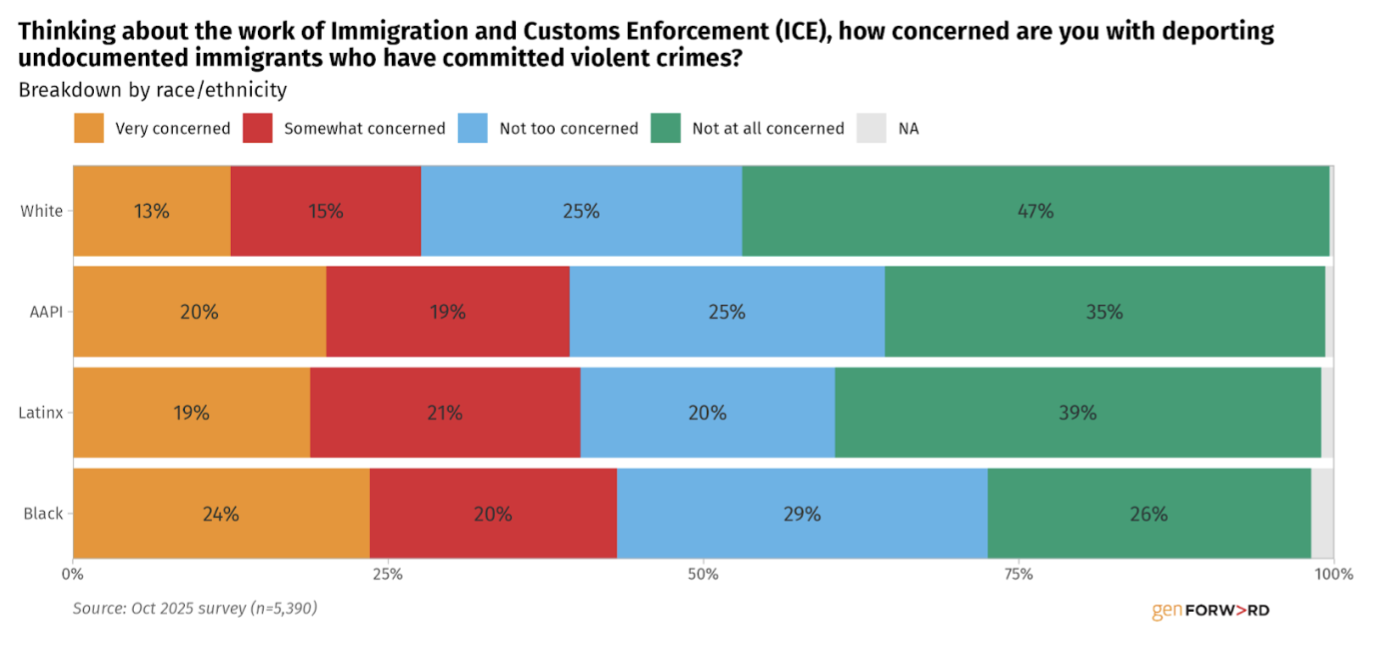
The expansion of federal immigrant enforcement sits at odds with public opinion on immigration policy and use of federal funds. Again, according to GenForward’s Good Governance Survey, over a third of respondents express significant concern about deporting undocumented individuals for minor offenses: 41% of Black, 40% of AAPI, 42% of Latinx, and 32% of white respondents said they were very concerned about deporting undocumented immigrants who have committed minor crimes such as traffic violations. However, consistent with existing public opinion data, a majority of young adults across racial and ethnic groups in our survey expressed little to no concern about deporting undocumented immigrants who have committed violent crimes.
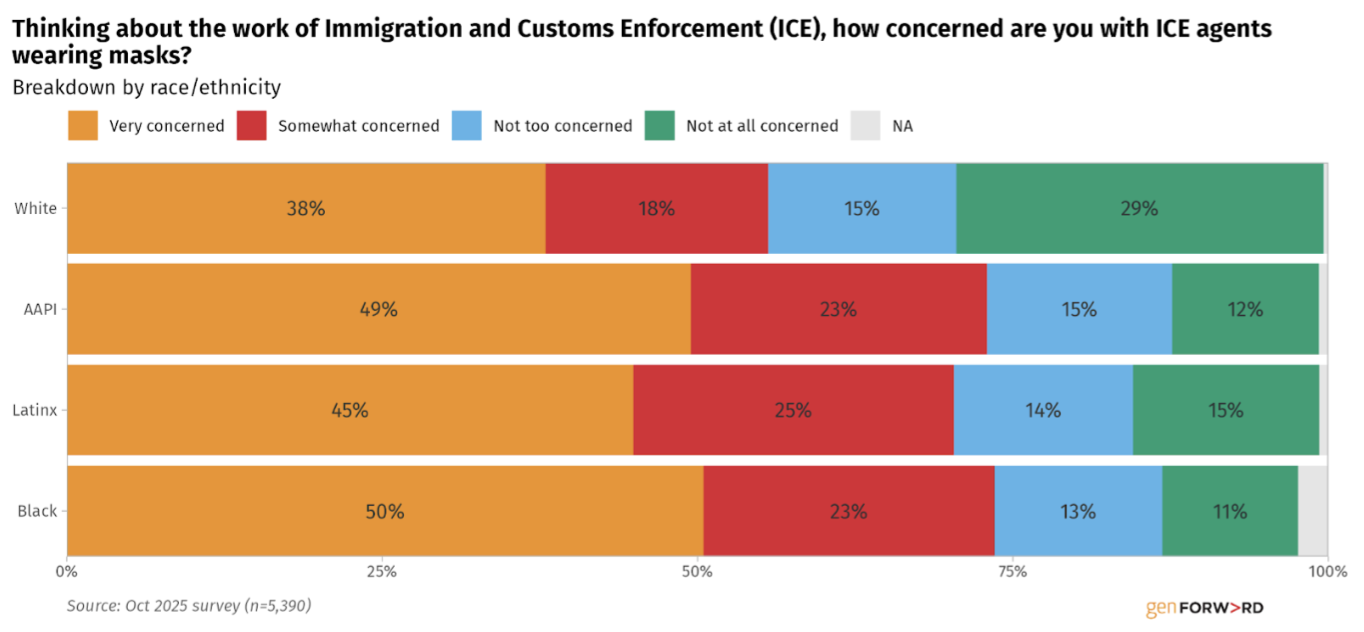
Additionally, respondents voiced concern about the draconian tactics used by ICE agents, with many troubled by federal agents wearing masks, concealing their badges, and shielding their identities during enforcement actions. Residents in Minnesota have said that federal agents who wear masks undermines transparency and accountability and contributes to a growing distrust of immigration enforcement agencies. Large majorities of young adults across racial and ethnic groups said they were either very or somewhat concerned about ICE agents wearing masks while carrying out operations.
Across the country, grassroots activists,community groups, and local businesses have mobilized to monitor and resist immigration enforcement. From Minneapolis to Santa Ana, rapid response networks have formed to track enforcement actions and alert immigrants of danger. Volunteers and immigrant rights organizers are offering regular workshops for people on how to interact safely with law enforcement officers and what legal protections are available. At the same time, state and local officials have taken formal political and legal action against the Department of Homeland Security and New York City Mayor-elect Zohran Mamdani voiced support for abolishing ICE altogether to instead resource housing, health care, legal services, and other forms of support for immigrants and their families.
The end of January saw a nationwide strike and boycott, with demonstrations, school walkouts, business shutdowns, and coordinated actions in Minneapolis, New York, Los Angeles, Chicago, San Francisco, and other cities. The momentum is expected to continue as communities call for greater transparency and accountability from federal agencies.
Diane Wong (She/Her) is an Assistant Professor in the Department of Political Science at Rutgers University, Newark. She holds a Ph.D. in American Politics and M.A. in Comparative Race, Ethnicity, and Immigration from the Department of Government at Cornell University. Her interests include American politics, Asian American activism, gender and sexuality, urban governance, comparative immigration, cultural and media studies, and community rooted research. Born and raised in Flushing, Queens in New York City, her research is intimately tied to the Asian diaspora and urban immigrant experience. Her work has appeared in PS: Political Science and Politics, Urban Affairs Review, Women’s Studies Quarterly, Amerasia Journal, Frontiers, and a variety of edited book volumes, journals, anthologies, podcasts, and exhibitions. She is author of Asian America Rising: New Directions for Political Activism (NYU Press, 2025) and You Can’t Evict A Movement: Housing Justice and Abolitionist Futures in New York City (Penn Press, 2026). Diane is a socially engaged artist and organizer, her latest exhibits include “Degentrification Archives” at Pace University Art Galleries and “Archive as Memorial” at Storefront for Ideas in New York City.
More Perspectives