By Justin Zimmerman
March 11th, 2026
Trust in the federal government is at its lowest point in United States’ history, and this distrust is a defining characteristic of the political lives of young people. Perceptions of government corruption, dissatisfaction with the major political parties, the deterioration of social services such as food stamps, and unprecedented overreach by federal agencies such as Immigration and Customs Enforcement (ICE), offer potential explanations for these trends. For many young people, U.S. government institutions such as Congress and the police do not have their best interests at heart. A steady drumbeat of state violence, challenges to their ability to vote, and a general resistance to youth taking up public spaces has solidified the idea that government—be it at the federal or local level— cannot be trusted.
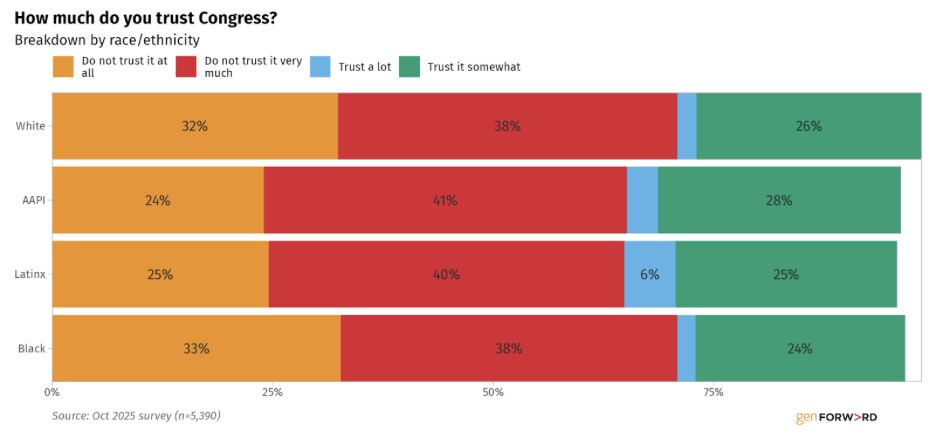
In our most recent Genforward Survey, fielded in October and November of 2025 in partnership with the Joyce Foundation, we asked a national sample of U.S. young adults to share their levels of trust and distrust towards a variety of federal and local political institutions. When asked about Congress, majorities of young adults across racial and ethnic groups reported that they do not trust this institution. Specifically, 70 percent of white, 65 percent of AAPI, 65 percent of Latinx, and 71 percent of Black respondents reported that they do not trust Congress very much or at all. When compared to Congress, we find that young people are comparatively more trusting of the U.S. Supreme Court, but less trusting of the presidential administration.
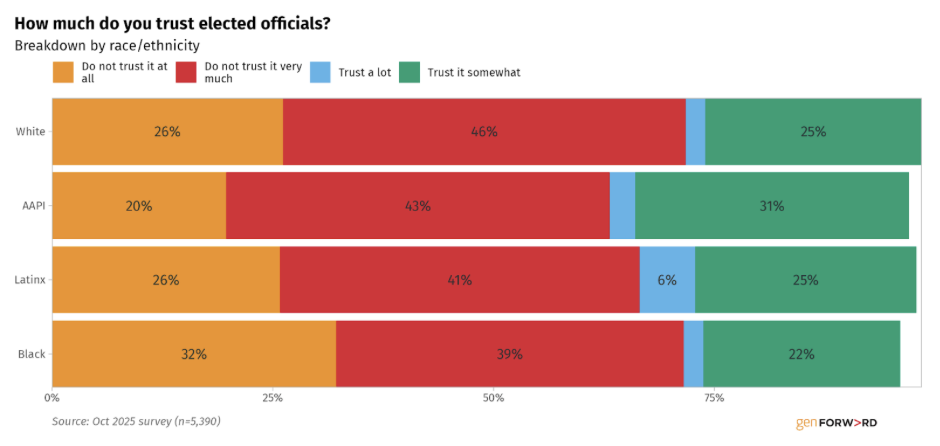
This distrust was not only aimed at Congress, but elected officials more broadly. Seventy-two percent of white, 63 percent of AAPI, 67 percent of Latinx, and 71 percent of Black young adults in our sample reported that they do not trust elected officials very much or at all. This sense of distrust may be linked to poor evaluations of both the Democratic and Republican parties. In comparison, respondents across racial and ethnic groups reported greater levels of trust toward scientists, universities, and the American people more broadly.
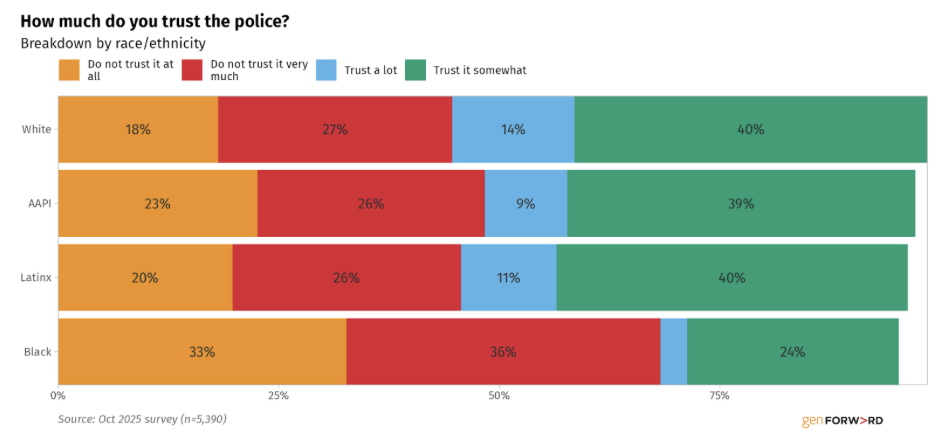
Distrust expanded beyond the federal government to local agencies as well. When asked whether young adults in our sample trust the police, 45 percent of white, 49 percent of AAPI, 46 percent of Latinx, and 69 percent of Black respondents reported that they do not trust the police very much or at all. These trends are consistent with existing research and our own GenForward data, which consistently show high rates of distrust toward the police among young Black people specifically.
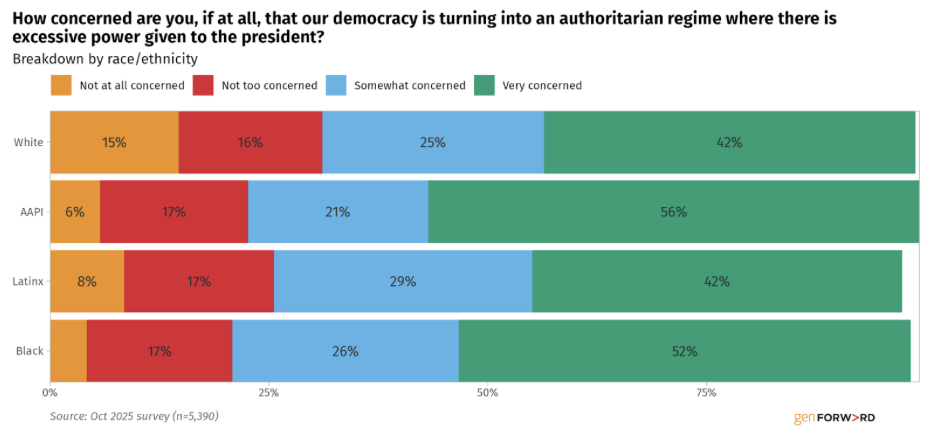
These attitudes may reflect (and exacerbate) concerns among young adults that the United States is falling short of its democratic ideals and practices. Across racial and ethnic groups, young people in our sample reported that they are concerned that the United States is turning into an authoritarian regime characterized by excessive presidential power. A sobering 67 percent of white, 77 percent of AAPI, 71 percent of Latinx, and 78 percent of Black young adults reported that they were somewhat or very concerned that the United States is turning into an authoritarian regime.
Young adults’ widespread distrust in multiple governing institutions and their concern about the rise of authoritarianism should not be read as a refusal to be a part of American democracy. Rather, it is a sign that accountability and equality have been neglected for far too long in the United States and that young adults are astutely clocking the weaknesses of our political institutions and processes.
Justin Zimmerman (He/Him) is an Assistant Professor of American Politics at UAlbany. His area of concentration is Black Politics and Urban Politics. His research aims to understand how Black Chicagoans work with institutions and neighbors they distrust to pursue common policy goals – in this case, to remedy state and community violence. Justin received his PhD from Northwestern University in 2023. He also is a proud alum of the University of Alabama where he received a Bachelor of Arts in political science and philosophy in 2009 and a Master of Public Administration with a concentration in organizational management in 2011. Prior to pursuing a career in academia, Justin resided in Washington, D.C., where he supported the Department of Treasury as an acquisitions consultant with Octo Consulting Group and served in multiple roles with the Department of State. Justin is published in Politics, Groups, and Identities as well as a forthcoming chapter in Edward Elgar. His insights on Black Politics and teaching can be found in The Atlantic, APSA Blog, and your local Albany newspapers.