By Cathy J. Cohen
April 14th, 2026
To say that the term affordability has become the buzzword of this political season would be an understatement. The growing prominence of the term “affordability” is evident in the press, among politicians, and even in the public’s Google searches.
The political success of focusing on affordability became evident in recent Democratic electoral wins, first in gubernatorial races in New Jersey and Virginia and then in the election of Zohran Mamdani as mayor of New York City. Undergirding the strength of the term, journalists and scholars contend, is its applicability across groups, with Lerer and Smith writing in the New York Times in December 2025 that “[O]ver the summer, affordability became the central political message of the Democratic Party. Unlike its previous economic slogans, the new rallying cry reached across lines of class, geography, race and gender.”
While many will claim the cross-racial appeal of the term affordability, I want to contest the race-neutral positioning of the term. Before our current “affordability boom,” the idea of affordability was associated with goods and services, and, I dare say, people, that were often racialized and considered less than. For example, until recently, the term “affordable housing” was more likely to evoke images of undervalued public housing and its presumed Black inhabitants than the current image of reasonably priced single-family housing. Nitsuh Abebe, in a December 2025 New York Times Magazinearticle, writes that “It wasn’t until the 1990s that marketers found a way to invert that dollar-store aura [of affordability] with concepts like ‘affordable luxury’ — ‘high-end’ brands selling a few mid-price items, letting consumers feel like they’re accessing goods of somebody richer.”
He continues arguing that “[P]olicymaking has its own way of reframing things. With housing, ‘affordable’ started off as a pleasant substitute for ‘low rent’ or ‘public,’ but it still pointed squarely at somebody else’s struggles. That changed as public housing policy shifted its focus toward private markets, as with the National Affordable Housing Act and, later, George W. Bush’s ‘ownership society’ push to increase home buying, with its frequent talk of single-family home affordability.”
So, as we encounter the affordability framework, we should keep in mind the evolving racial and racist connotations associated with the idea of affordability and how it has become accepted into the mainstream, namely as it is linked, in particular, to white working- and middle-class voters.
While there is much to contemplate about the racial connotations associated with the idea of affordability, at present, affordability represents the inability of families to acquire a middle-class lifestyle—owning a home, sending their children to college, and accessing seemingly essential benefits and rights such as health care and retirement.[1]
[1] I should note that I am not suggesting that there has been a flat or equal impact on housing or any measure of affordability during the last 50 years. Instead, we should expect those communities already economically marginal and disproportionately suffering from racial capitalism, to bear a disproportionate burden of the affordability crisis.
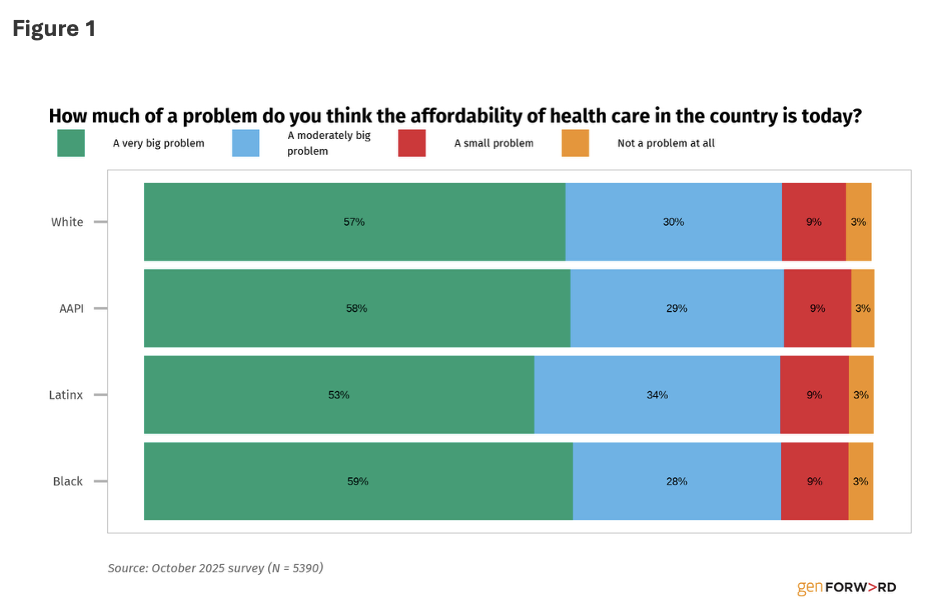
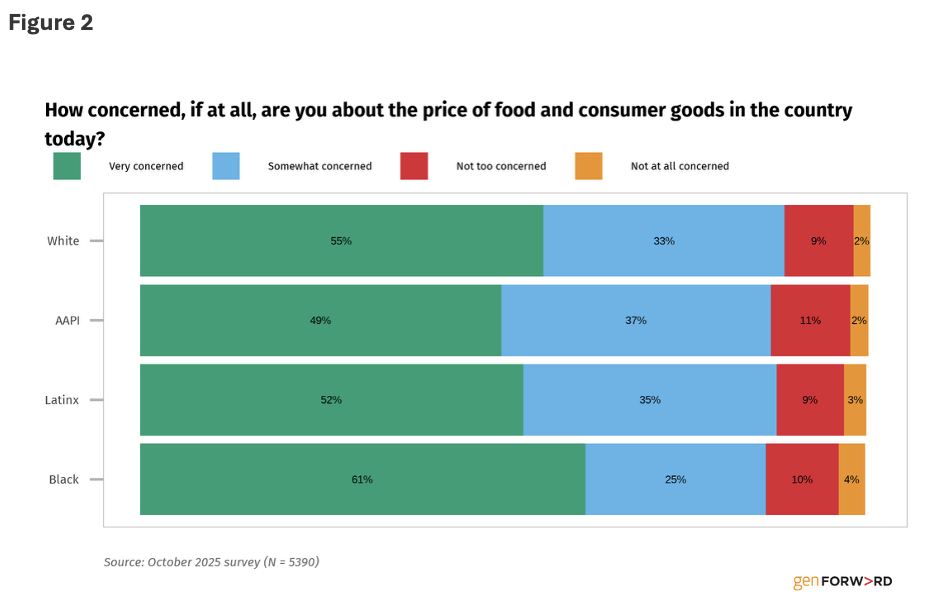
And while much of the discussion of the affordability crisis centers on the availability and cost of housing, the general idea of an affordability crisis extends to other policy areas. For example, in our November 2025 GenForward data, we ask a series of questions about affordability concerns regarding health care and consumer goods. In Figures 1 and 2, we find overwhelming concern about affordability among those ages 18-42 across racial and ethnic groups.
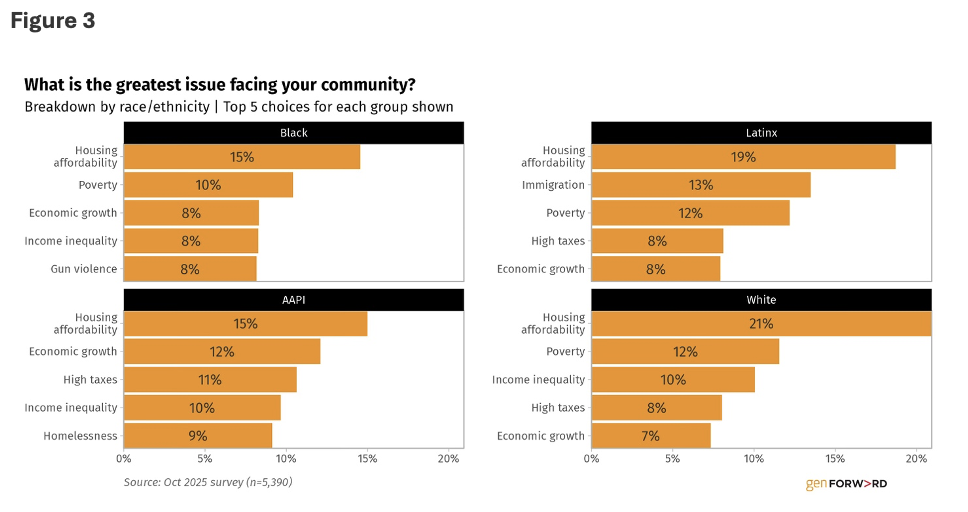
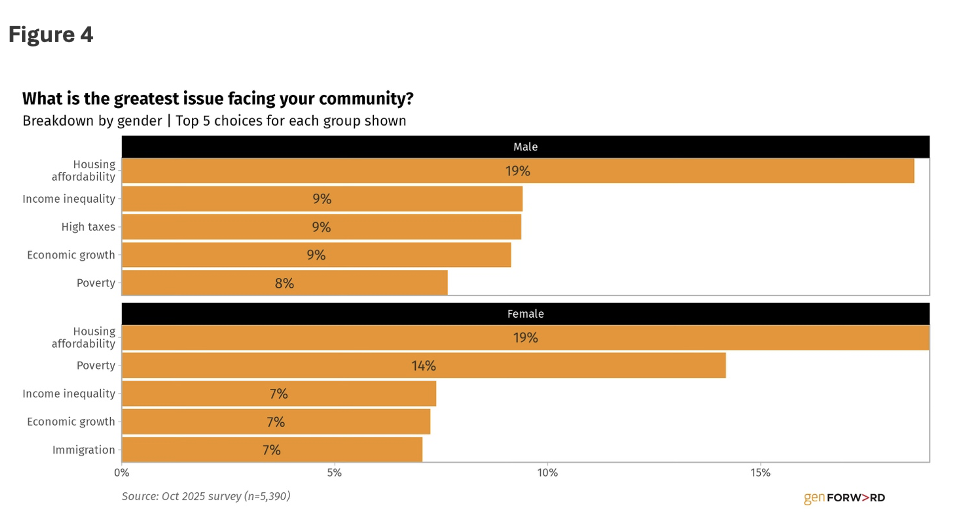
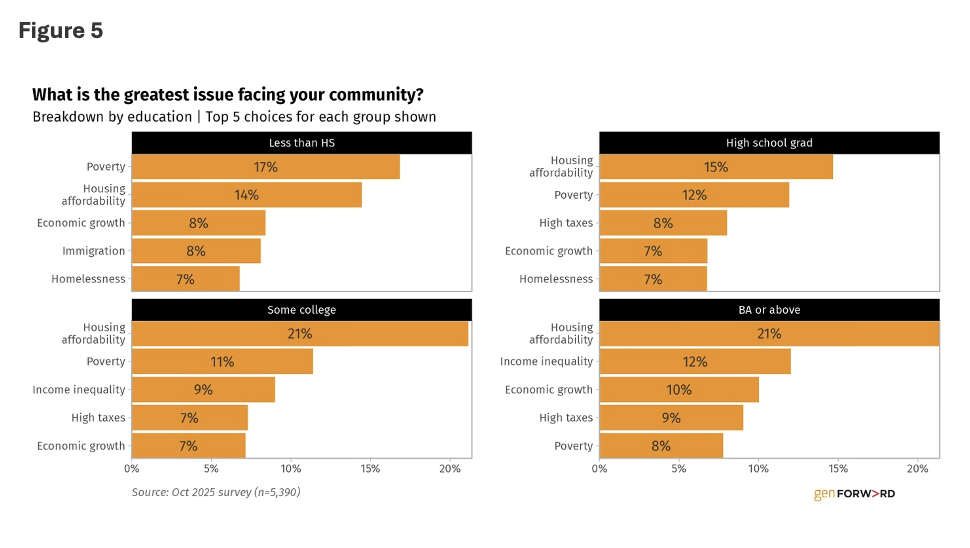
The persistence of affordability as a prominent concern in public opinion is also evident when we ask respondents about the most important issue facing their community. Repeatedly, in Figures 3-5, housing affordability emerges as one of the top two issues—and typically the top issue—young adults are worried about in their communities. This finding persists across racial, ethnic, gender, and educational groups. Consistently, young adults are telling us that affordability is structuring their lives and opportunities.
Despite the breadth and prominence of affordability concerns throughout our GenForward data, it was a different set of findings in the same data set that make clear that politicians, journalists, and advocates may be thinking incorrectly or incompletely about the topic of affordability, at least as it relates to the lives of young adults. It was our respondents’ unwillingness to view affordability purely as an economic issue divorced from the functioning of democracy that was galvanizing for me. Specifically, when we asked respondents to pick the three most important factors needed for democracy (not the economy) to work well, housing affordability, surprisingly, kept showing up in their top three responses. I want to be clear that, on a question about what is needed for democracy to work well, respondents usually choose answers such as free and fair elections or limiting money in politics. So, to have so many of the young adults in our nationally representative survey connect affordability to democratic possibility was truly eye-opening. And to make the point more forcefully, the inclusion of affordability as an essential component of a well-functioning democracy was a pattern that showed up for most subgroups in our data as seen in Figures 6-8.
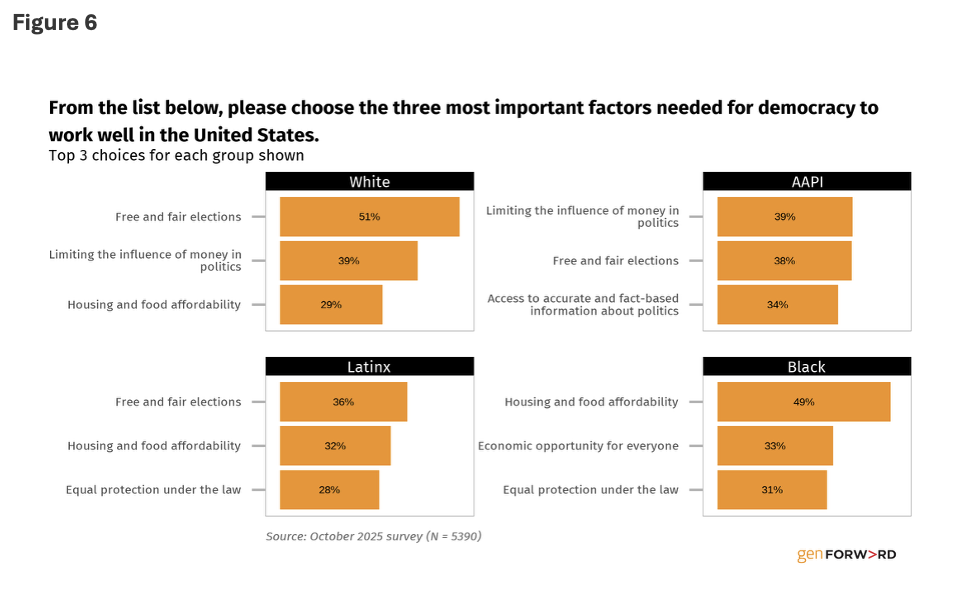
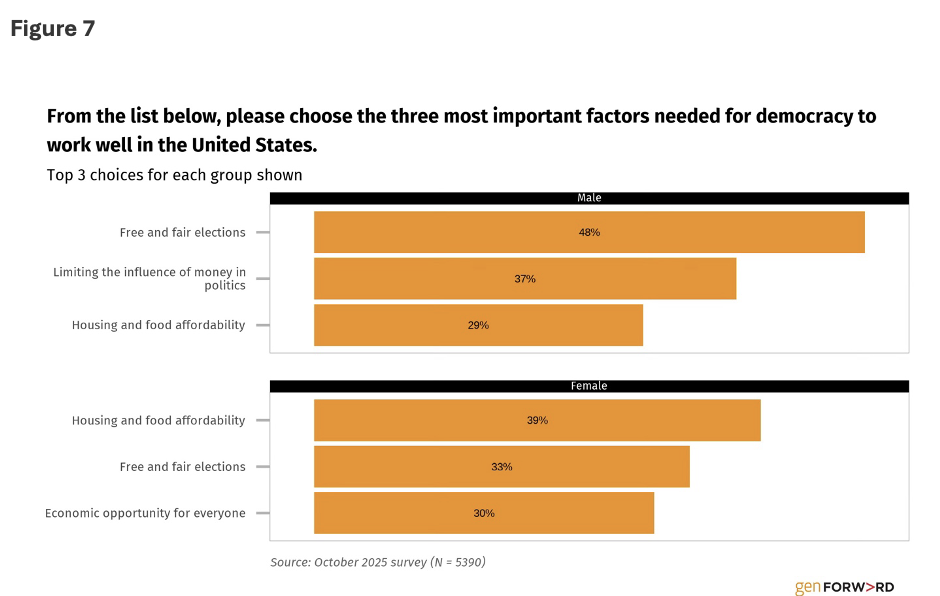
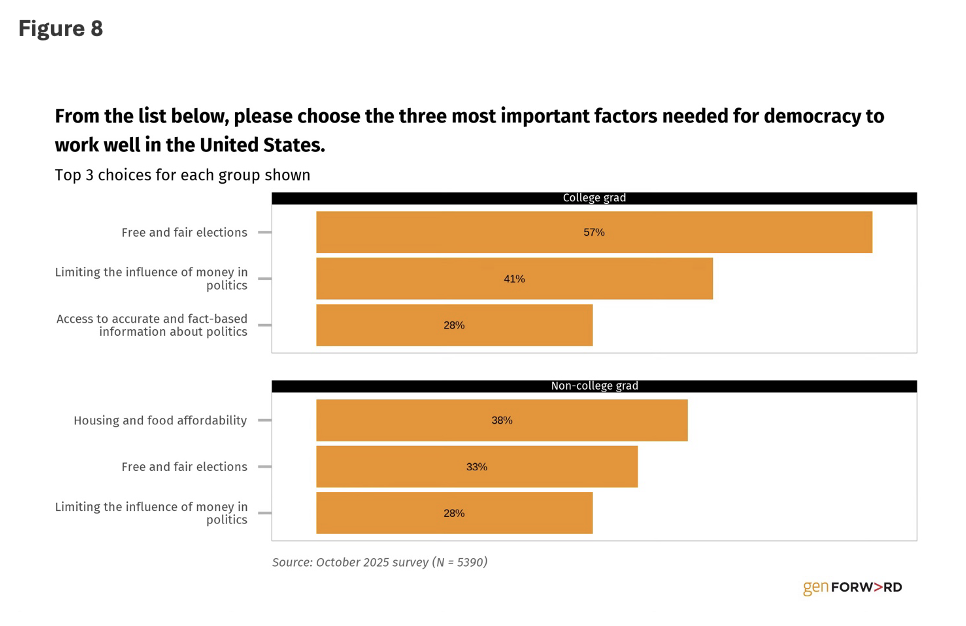
After reviewing these findings, it seems clear that young adults seem to be rejecting the premise that affordability is purely an economic or even lifestyle concern. Instead, they see affordability, or access to essential services and rights, as part of what they believe democracy should ensure. For young adults, affordability is an important marker of what a fully functioning democracy must provide its people. It was, in fact, the false and simplistic choice between what had been framed as an overriding concern with affordability or a deep concern for the health and future of our democracy that we found repudiated in our findings. Young adults understand affordability as democracy!
I want to be clear that, for many young adults, often from poor and racialized communities, the problem of affordability and the failure of democracy are not new. As scholars such as Du Bois and Mills remind us, the promise of “the essentials” was never part of the racial social contract. So, at the very least, these data should complicate our presumed understanding of both affordability and democracy, making clear the need to build political campaigns that extend the reach of the framework of affordability beyond the purchase of a house to include the provision of the essentials of life to everyone.
Cathy J. Cohen (She/Her) is the D. Gale Johnson Distinguished Service Professor at the University of Chicago. She formerly served in numerous administrative positions, including chair of the Department of Political Science, director of the Center for the Study of Race, Politics, and Culture, and deputy provost for Graduate Education at the University of Chicago. She was the inaugural chair of the Department of Race, Diaspora, and Indigeneity (RDI) at the University of Chicago. Cohen is the author of two books: Democracy Remixed: Black Youth and the Future of American Politics (Oxford University Press 2010) and The Boundaries of Blackness: AIDS and the Breakdown of Black Politics (University of Chicago Press 1999), and co-editor with Kathleen Jones and Joan Tronto of Women Transforming Politics: An Alternative Reader (New York University 1997). Cathy’s work has been published in numerous journals and edited volumes including the American Political Science Review, GLQ, NOMOS, and Social Text. Her general field of specialization is American politics, although her research interests include African-American politics, women and politics, lesbian and gay politics, and social movements. She is also the founder and Director of the Black Youth Project.