By Devin Green
May 12th, 2026
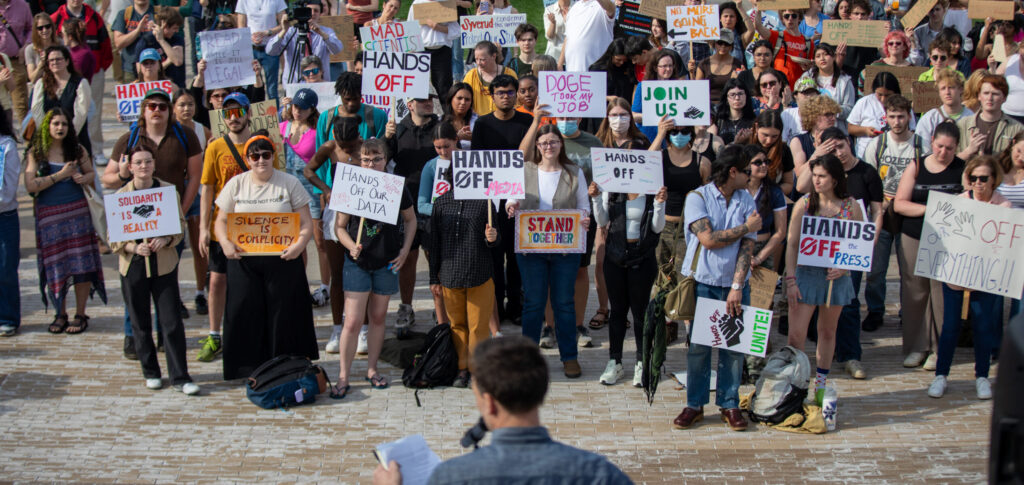
Since the second inauguration of Donald Trump, the United States has witnessed the three largest single-day protest events in its history. Millions of people have taken to the streets to denounce ICE raids and racial profiling, the erosion of social safety protections, voter suppression, and other authoritarian actions under the mantra: “No Kings!” The coalition of grassroots organizations coordinating the “No Kings” argue that their movement represents the nation, writing:
“No Kings” is more than just a slogan; it is the foundation our nation was built upon. Born in the streets, shouted by millions, carried on posters and chants, it echoes from city blocks to rural town squares, uniting people across this country to fight dictatorship together.
However, their opponents have dismissed these claims. Speaking to reporters in October, Trump downplayed the representativeness of these protests, saying:
“I looked at the people — they’re not representative of this country. And I looked at all the brand new signs… I guess it was paid for by [George] Soros and other radical left lunatics,” Trump continued. “It looks like it was. We’re checking it out.”
Trump was not alone in suggesting these mass protests were, in fact, conspiracy. House Speaker Mike Johnson accused the Democrats of fomenting “No Kings” in October to provide political cover for the government shutdown. Conservative political commentator Ben Shapiro argued that the 8 million-person protests on March 28th were actually funded by “shadowy figures,” including a tech billionaire based in Shanghai. Minnesota Congressman Tom Emmer described the protests as a “hate America rally” led by the “terrorist wing” of the Democratic party. On May 2nd, conservative commentators in the media and on X used King Charles’ visit to Congress to delegitimize the “No Kings” movement, with Florida Congressman Greg Steube writing: “Funny how the ‘No Kings’ crowd is nowhere to be found. Guess the outrage depends on who’s talking?”
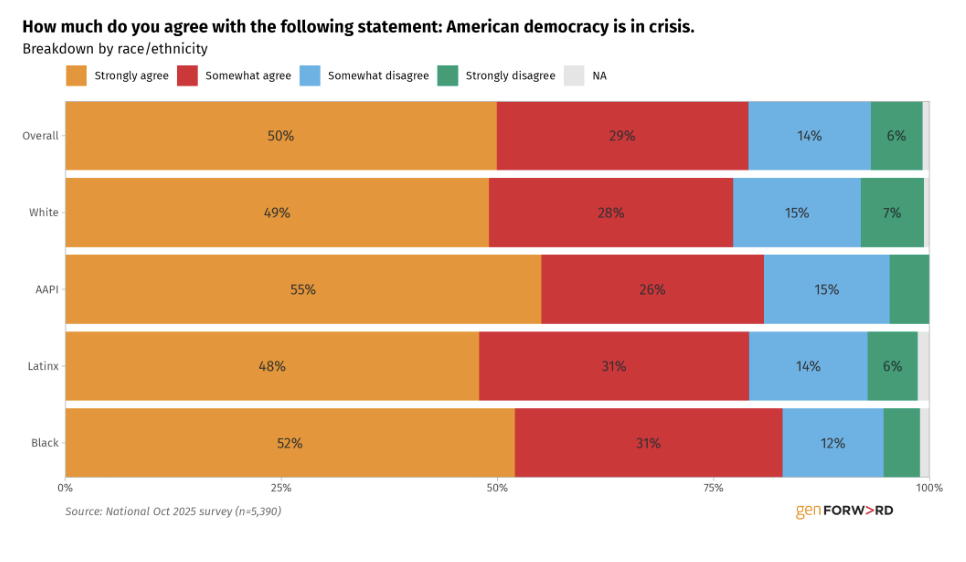
Criticisms of “No Kings” as astroturfed and politically disingenuous are clearly at odds with the movement’s scale. Rather, these critiques aim to delegitimize the foundational claim advanced by these protests: that authoritarianism is on the rise and threatens American democracy. Our team at the GenForward project surveyed a representative sample of young Americans (18-42) in October 2025, one week after the second “No Kings” protest. GenForward survey data is unique in that it provides significant oversamples of Black, Latinx, and Asian American Pacific Islander (AAPI) young adults, allowing us to more deeply examine differences and similarities in these groups’ perceptions of a range of political issues including their thoughts about authoritarianism in the United States. Our data broadly suggests that young Americans overwhelmingly believe that our democracy is in crisis (see Figure 1). Specifically, 79 percent of young adults in our sample reported that they either strongly or somewhat agree that American democracy is in crisis.
Figure 1
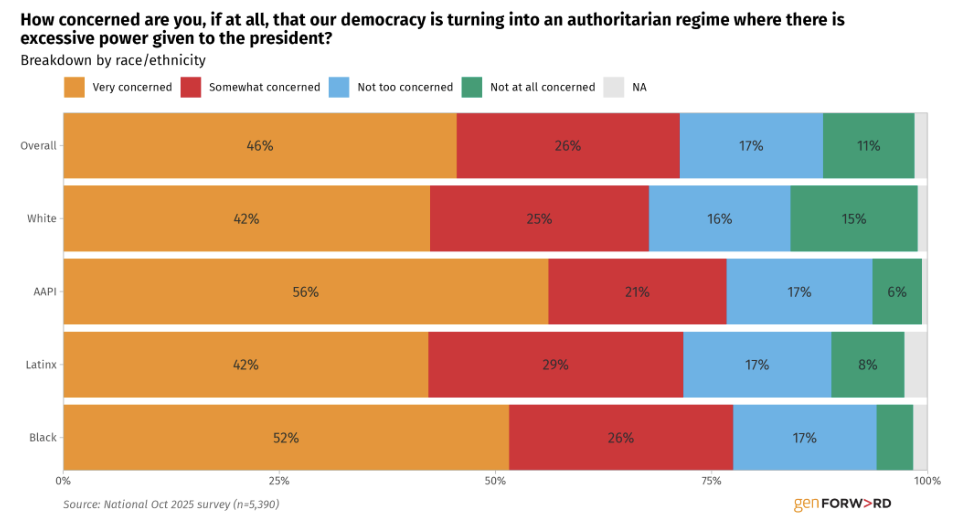
Large majorities of respondents–72%—also expressed concern that our democracy is turning into an authoritarian regime where excessive power is given to the president (See Figure 2). We find that concern about authoritarian presidential power is pronounced across all racial and ethnic groups, although white and Latinx Americans are comparatively less concerned than their AAPI and Black peers (see Figure 2). When we asked our respondents what they thought the three greatest threats to democracy are today (see Figure 3), 34% selected excessive presidential power—the second most common response– following the first overall choice of corruption and greed at 39%.
Figure 2
The persistence of affordability as a prominent concern in public opinion is also evident when we ask respondents about the most important issue facing their community. Repeatedly, in Figures 3-5, housing affordability emerges as one of the top two issues—and typically the top issue—young adults are worried about in their communities. This finding persists across racial, ethnic, gender, and educational groups. Consistently, young adults are telling us that affordability is structuring their lives and opportunities.
Figure 3

Similar to their concern about concentrated presidential power, we also find that young adults are concerned about presidential control over the media and military. While large majorities of all young adults across racial and ethnic groups report that they are either very or somewhat concerned, AAPI and Black respondents more frequently report that they are concerned about these issues than their white and Latinx counterparts. (see Figure 4 and Figure 4).
Figure 4
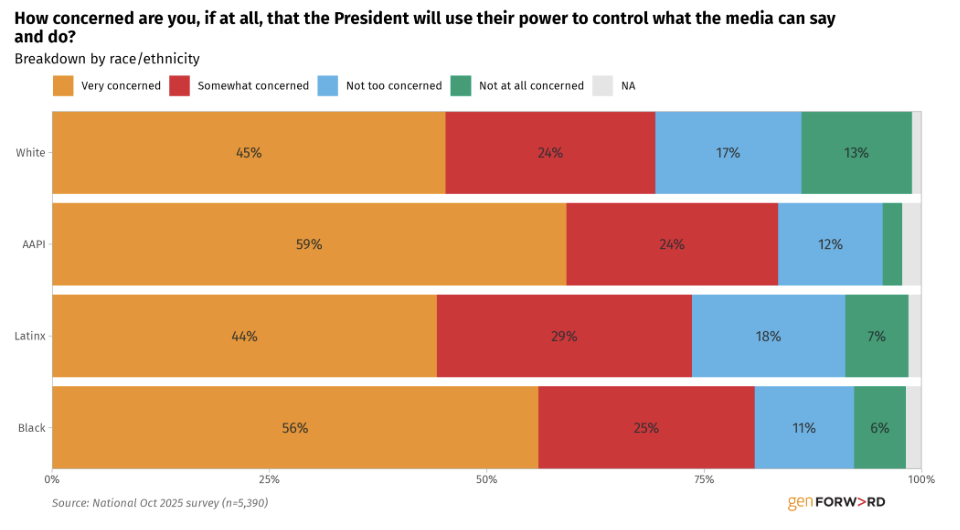
Figure 5

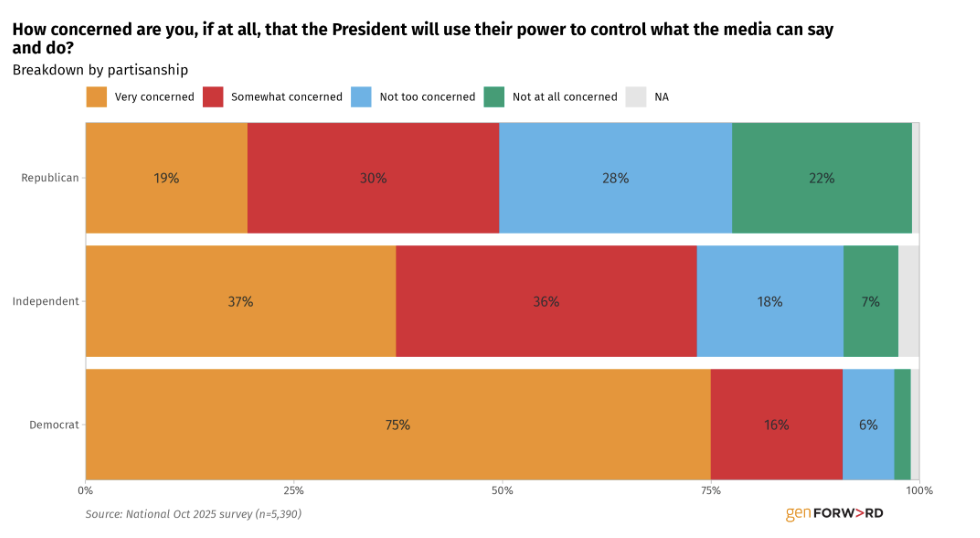
Perhaps unsurprisingly, self-identified Democrats are significantly more concerned that American democracy is turning into an authoritarian regime. However, 45 percent of young Republicans also claim to be very or somewhat concerned about this trend (see Figure 6). The same pattern appears when we asked young adults about their concern that the president will use their power to control what the media can say and do (see Figure 7). We also observe that large numbers of Republicans believe that no president should be able to eliminate congressionally approved government programs (48%), impose tariffs without congressional authorization (43%), and deport legal immigrants (50%) or persecute citizens (67%) who protest against policies or positions of the United States.
Figure 6

Figure 7
Partisan claims that the “No Kings” movement represents the interests of only a narrow slice of Americans are wrong and contradict much of what has been found in rigorous and reliable public opinion surveys. That said, there are concerns that youth and young adults are often absent from the “No Kings” protests and the crowd skews older and predominately white. While this could be true on the ground, the data discussed here suggests that young adults, especially young people of color, are acutely concerned that our democracy faces significant threats from authoritarianism.
Devin Green (He/Him) is a doctoral student in the Department of Political Science, a National Science Foundation Graduate Research Fellow, and Neubauer Family Distinguished Doctoral Fellow. His research interests are in racial politics, organizing and social movements, corporate power, and policing. His current focus is on the role of corporations and nonprofit organizations in shaping criminal justice politics in the United States.
During his time at the University of Chicago, Devin has TAd courses on racial formation and race in social movements in the United States. His work has been supported by the Mansueto Institute for Urban Innovation’s Doctoral Fellowship, the APSA Diversity Fellowship Program, and the Center for the Study of Race, Politics, and Cultures’ research incubator.