By Diane Wong
June 17th, 2026
At a moment when public trust in American institutions is declining and polarization dominates political discourse, understanding how AAPI young adults think about democracy offers important insights into the future of American politics. Nearly one-third of all eligible Asian American voters are Gen Z or Millennial, making them one of the fastest-growing segments of the electorate. As Democrats and Republicans compete for their support, public discussions often focus on party preference and electoral outcomes, while paying far less attention to how AAPI young adults understand democracy, what counts as meaningful participation, and whether existing institutions are capable of living up to those ideals.
Recent GenForward focus group data collected in April 2026 suggest AAPI young adults are approaching politics through a broad set of concerns. Our AAPI focus group consisted of 11 young adults residing within metro areas throughout the Midwest and included seven men, four women, and one transgender individual. The participants ranged in age from 24 and 42 and the majority identified as Democrats. Participants grappled with questions of affordability, political polarization, corporate influence, accountability, and government responsiveness. Their reflections reveal a generation that remains committed to democratic participation while expressing growing skepticism about the responsiveness of political institutions. As we approach the 2026 midterm elections, a key challenge may be less about persuading young voters whom to support and more about whether they believe ordinary people can meaningfully shape political outcomes.
When discussing declining trust in government, AAPI young adults often pointed to the outsized role of corporations in shaping public policy. One participant shared a striking example from her workplace, “I find that corporate interest has more of a sway on what decisions actually go through, what laws get passed. I work for a pretty large corporation currently, and there was a panel where we were talking with the lead of the legal team of our company. I, at the time, did not even know that our legal team had a 24/7 group that operated out of DC and lobbied in favor of my corporation’s interests. One interesting thing that was brought up in that panel was someone asked what party our company wants to see in power…They [said] that they just want the legislature and the executive branch to be in the power of different parties, because there being different parties in power means that new laws don’t get passed, which allows the corporations to not spend money lobbying their interest at the national level.” Her comment reflects a broader concern that emerged throughout the discussion and was shared by many, that powerful corporate interests benefit from political gridlock by keeping individuals divided and undermining political solidarity.
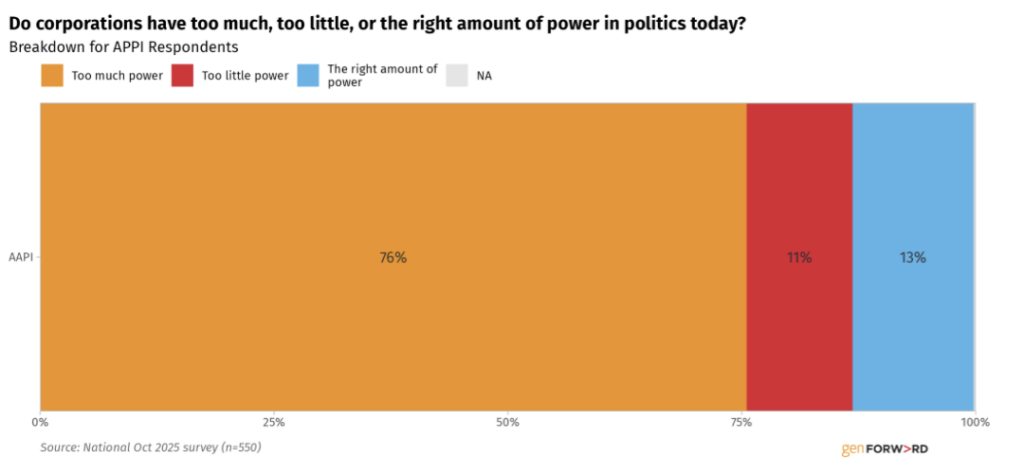
These sentiments are further reflected in survey data from our Good Governance Survey collected in November 2025. We asked respondents whether they could trust corporations and whether they felt corporations had an outsized role in politics. As demonstrated by Figure 1, 75 percent of AAPI young adults in our sample reported that they did not trust corporations very much or at all. Similarly, Figure 2 shows that 76 percent of AAPI respondents said that corporations have too much power in politics today.
Figure 1
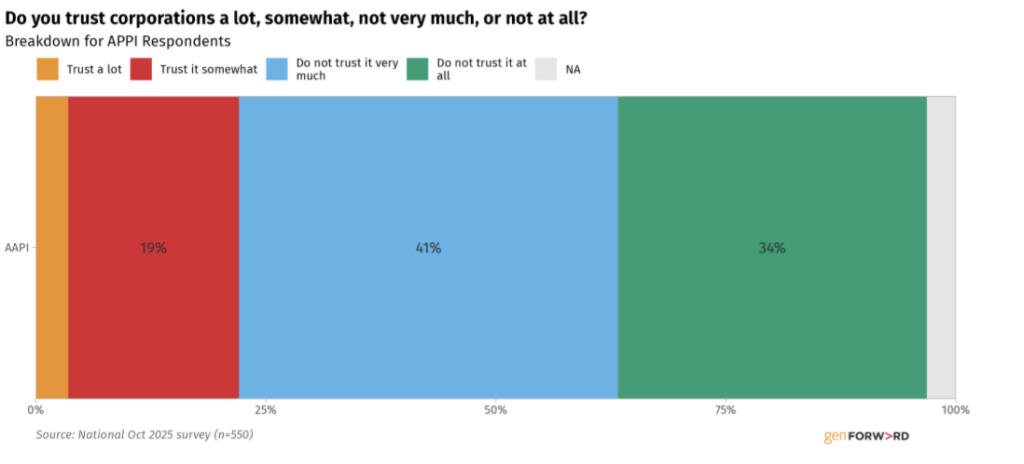
Figure 2
AAPI young adults in our focus group also connected declining trust in government to the broader effects of political polarization. Several worried that partisan divisions have become more entrenched, making it difficult to engage across ideological divides and to build opportunities for democratic deliberation. One participant pointed to social media as a force that deepens political divisions rather than fostering generative dialogue, he observed, “If you watch too much left-wing content, you’re just going to see the same people. If you watch right wing content, your mind is going to be right. With this kind of thing, people are going to be so divided, and they cannot speak in the same language.” These comments were shared by many in the group and suggest that many AAPI young adults view polarization as a persistent challenge to democratic cooperation and sustaining the forms of civic deliberation necessary for governance.
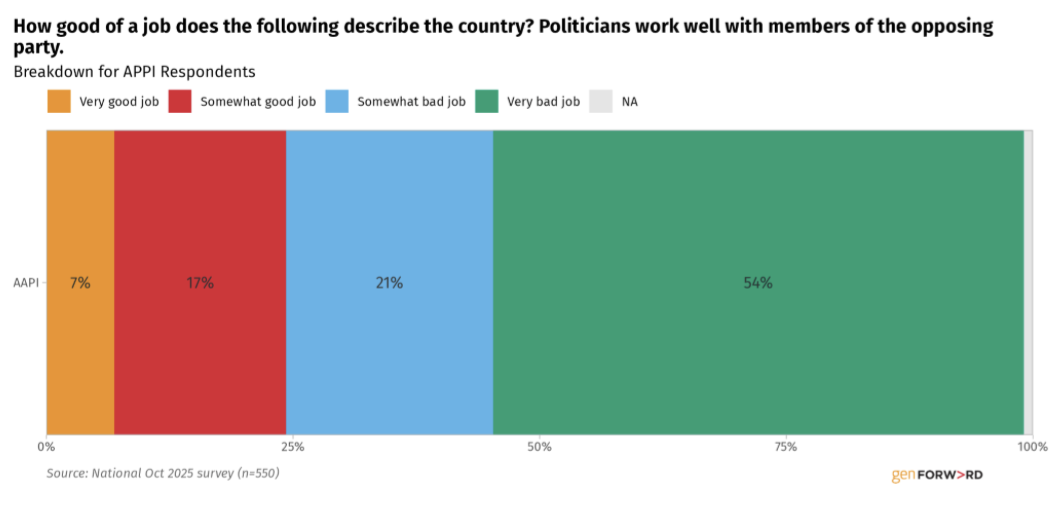
Our survey data underscores the concern about the lack of bipartisanship in government that was articulated in our AAPI focus group. In our November 2025 survey, we asked participants how important it was for members of the opposing party to work with each other in an ideal government. As demonstrated by Figure 3, 93 percent of AAPI young adults said that bipartisanship was either very or somewhat important. However, as seen in Figure 4, 75 percent of AAPI respondents expressed skepticism that this ideal accurately reflects the country presently.
Figure 3
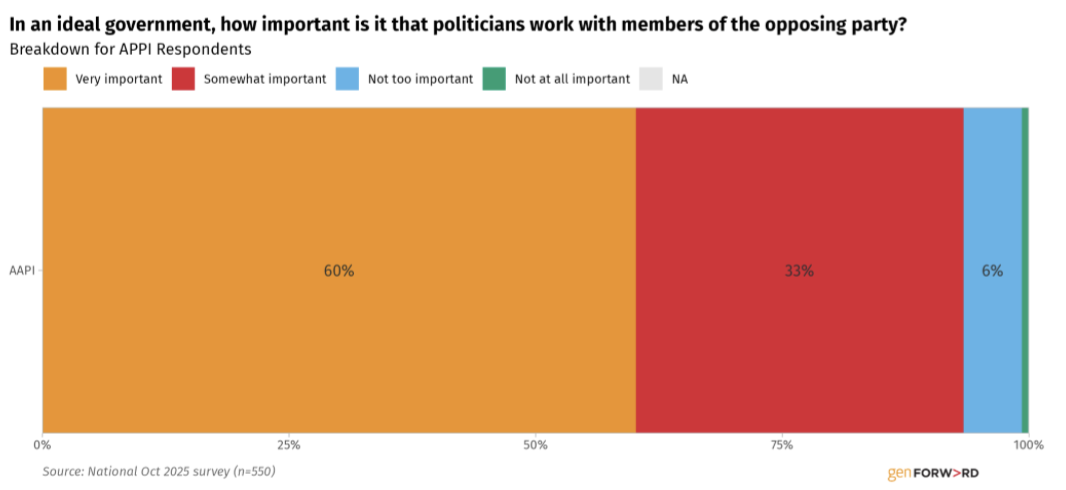
Figure 4
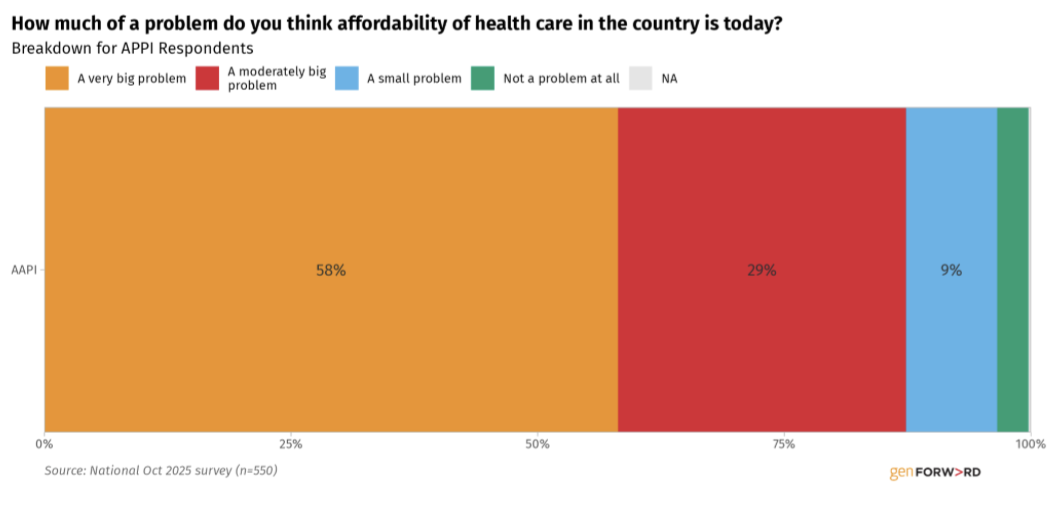
Affordability emerged as a major concern shaping how participants think about the government. For many AAPI young people, rising healthcare, childcare, housing, and education costs are evidence that the government is struggling to provide the economic security and social support systems that families need. One participant described the financial burden of navigating the healthcare system despite having insurance, “Right now, my family pays over $54,000 per year in childcare. We have two young kids, one of whom has medical problems in addition to the exorbitant cost of healthcare. Right now, insurance eats up, you know, I think $1,500 a month. It basically is my entire paycheck.” This strain is further reflected in Figure 5, which shows that 58 percent of AAPI young adults in our sample report affordability of health care as a very big problem. For many young people who live in financial strain, affordability becomes a measure of democracy itself and of whether existing institutions are capable of responding to the needs of the people.
Figure 5
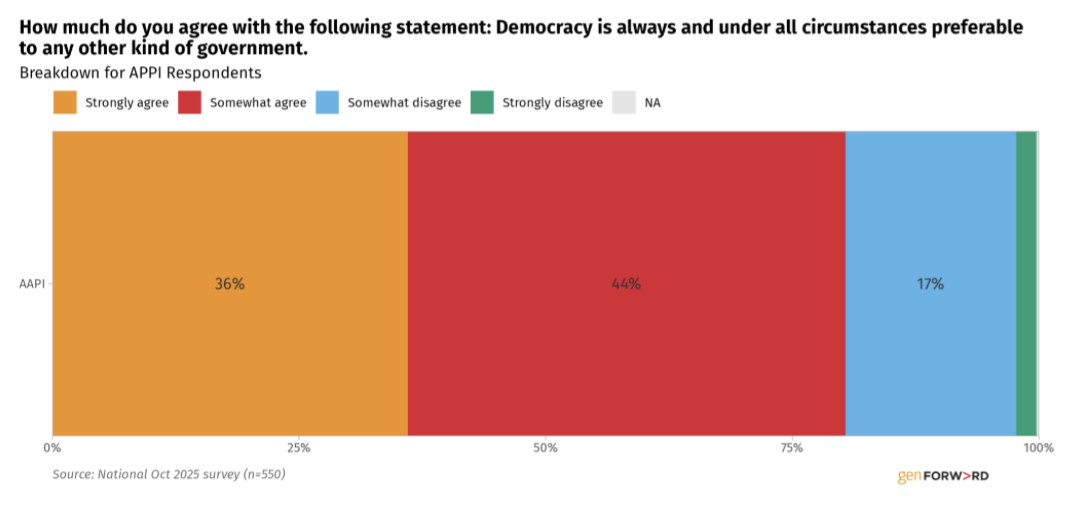
Despite these concerns, those who participated in the focus group conversation did not reject democracy itself, and many even articulated a robust vision of democracy that emphasized meaningful opportunities for representation and political voice. One participant reflected, “To me, democracy means the protection of minority groups, regardless of their race, ethnicity, background, or socioeconomic status, the language they speak, or the political stance they have.” While some emphasized voting as the foundation of a democratic society, others were quick to point out the gap between democratic ideals and democratic practice. In fact, one participant reflected on how “gerrymandering controls opinions and votes, the way the electoral college filters down the opinions of minorities, and the way incarceration affects people to have a voice in government for the rest of their lives.” This tension emerged in our survey data as well. As shown in Figure 6, while 80 percent of AAPI respondents somewhat or strongly agreed that democracy is always and under all circumstances preferable to other forms of government, 20 percent somewhat or strongly disagreed with this sentiment.
Figure 6
Despite these tensions, one of the most important findings from both our focus group and survey data was the expansive understanding AAPI young adults hold of democratic participation, as something that extends beyond elections and formal political institutions. For instance, several participants viewed mutual aid, community support, and local forms of collective action as important expressions of civic engagement. As one participant explained, “The reason I feel so obligated to be involved in my local community is because a lot of the things that I do for my community are things that the government doesn’t offer as social services. So when I babysit for my neighbors, it’s because we don’t have access to childcare like many OECD countries make available to parents.” Increasingly, many AAPI young people understand democratic participation as the daily work of meeting community needs, especially when government institutions fall short.
These findings challenge narrow portrayals of AAPI young adults as simply another voting bloc to be mobilized during election season. Participants expressed strong commitments to democratic values, and at the same time voiced deep concerns about institutional trust and democratic responsiveness. Perhaps most importantly, they articulated a capacious understanding of democracy that extends beyond elections and formal political institutions into everyday practices of mutual aid and community care.
Diane Wong (She/Her) is an Assistant Professor in the Department of Political Science at Rutgers University, Newark. She holds a Ph.D. in American Politics and M.A. in Comparative Race, Ethnicity, and Immigration from the Department of Government at Cornell University. Her interests include American politics, Asian American activism, gender and sexuality, urban governance, comparative immigration, cultural and media studies, and community rooted research. Born and raised in Flushing, Queens in New York City, her research is intimately tied to the Asian diaspora and urban immigrant experience. Her work has appeared in PS: Political Science and Politics, Urban Affairs Review, Women’s Studies Quarterly, Amerasia Journal, Frontiers, and a variety of edited book volumes, journals, anthologies, podcasts, and exhibitions. She is author of Asian America Rising: New Directions for Political Activism (NYU Press, 2025) and You Can’t Evict A Movement: Housing Justice and Abolitionist Futures in New York City (Penn Press, 2026). Diane is a socially engaged artist and organizer, her latest exhibits include “Degentrification Archives” at Pace University Art Galleries and “Archive as Memorial” at Storefront for Ideas in New York City.