By Matt Nelsen
July 15th, 2026
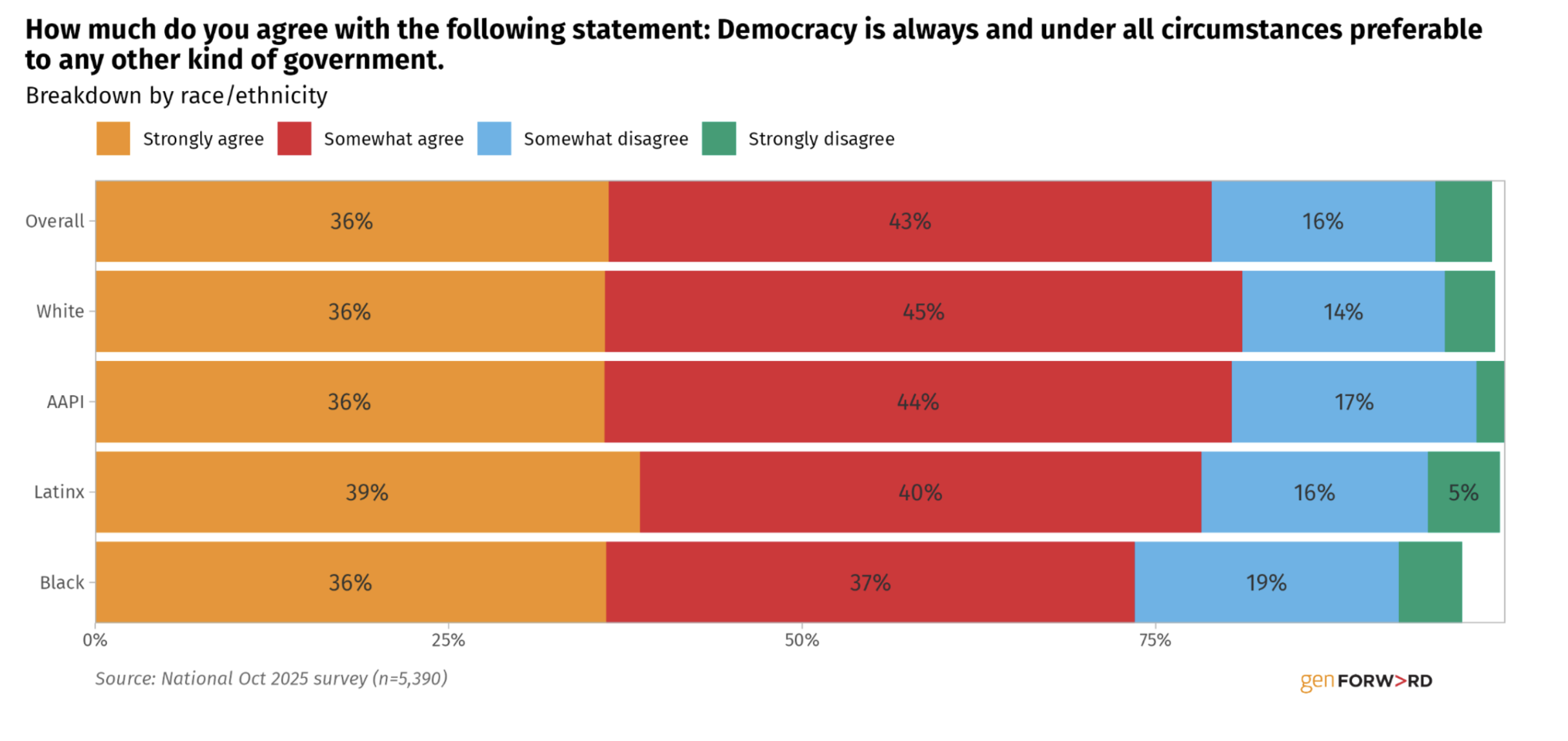
The 250th Anniversary of America’s founding has been characterized by a mix of celebration for some and deep disillusionment for others. For young Americans, a strong distrust of government, significant affordability concerns, and the concentration of executive power has contributed to a belief that U.S. Democracy is in crisis. Even still, a majority of young adults across racial, ethnic, and partisan divides included within our nationally representative Good Governance Survey fielded in November 2025, report that they believe that democracy is preferable to other forms of government. As demonstrated by Figure 1, 79 percent of young adults included in our sample said that they somewhat or strongly agree that democracy is always preferable to any other kind of government. How should we make sense of tension between young adults’ democratic convictions alongside their dissatisfaction with American government? If young adults were given the opportunity to reimagine American democracy 250 years after the nation’s founding, what would that system look like?
In April 2026, the GenForward research team conducted a series of eight focus groups with 94 young adults living in Midwestern states. The sample included16 AAPI, 22 Black, 20 Latine, one multiracial, and 35 white young adults ranging in age from 18 to 42. Fifty-three of these individuals identified as Democrat, 19 as Independent, and 22 as Republican. Participants grappled with a number of topics including affordability, power, corruption, and the reforms that would be needed in order for American government to function more effectively. Across racial, ethnic, and partisan divides, their reflections reveal both strong commitments to democratic norms and a desire to significantly reshape America’s democratic system. Four primary policy recommendations emerged in these discussions related to reimagining American democracy: 1) doing away with the electoral college, 2) expanding access to ranked choice voting, 3) removing outside money from politics, and 4) placing age and term limits on elected officials.
Figure 1
The United States Constitution specifies that the president and vice president are elected by a pool of electors from each state—corresponding to the size of each states’ congressional delegation—rather than by popular vote. In practice, this electoral college system has historically benefited the Republican Party. In our focus groups, participants frequently noted that replacing the electoral college with a popular vote system would enhance the fairness of presidential elections and allow American democracy to function more effectively. Dorothy, a 39-year-old Black woman from Illinois shared the following: “My idea of a healthy democracy in regards to voting and the political process, is that the electoral college should be done away with. Number one. I think that when we elect officials, it should be done by a popular vote.”
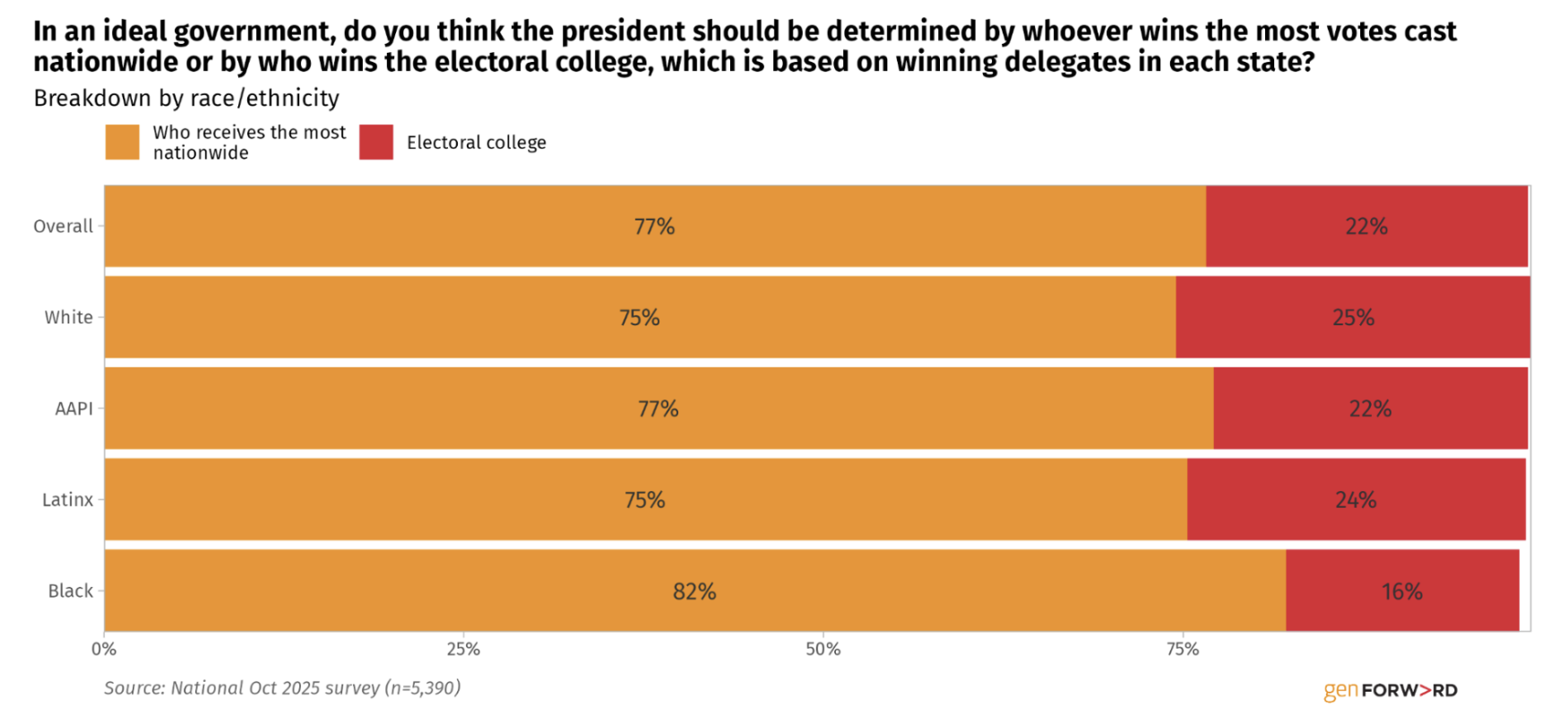
This sentiment is widely shared by the individuals included within our Good Governance Survey. Overall, as highlighted in Figure 2, 77 percent of respondents included in our sample stated that the president should be determined by whoever receives the most votes. This approach to administering presidential elections is particularly popular among Black respondents, with 82 percent reporting that winners in these elections should be determined by popular vote.
Figure 2
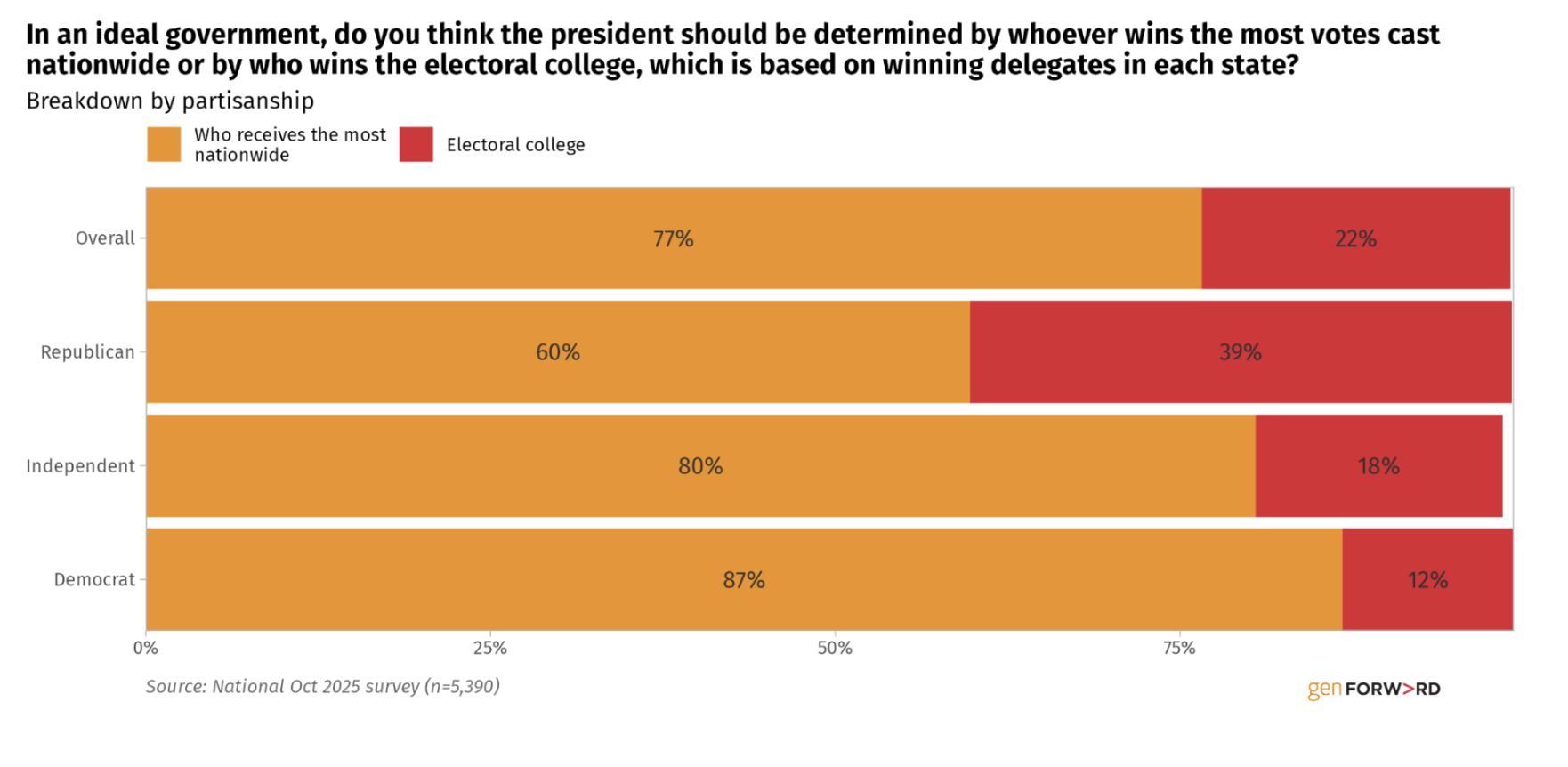
While Democrats in our focus groups, such as Dorothy, were more likely than Independents and Republicans to advocate for abolishing the electoral college, we did find popular support for this reform within our Good Governance Survey data. As demonstrated by Figure 3, both Independents (80 percent) and Democrats (87 percent) were more supportive of the popular vote determining the outcome of presidential elections, while Republicans—the beneficiaries of the electoral college system—were less supportive of this reform, although a majority (60 percent), did support this policy change.
Figure 3
Participants in our focus groups often noted that reforms to how the U.S. elects the president should be coupled with an expansion of ranked choice voting—a voting system in which voters rank candidates by preference rather than making a single selection. Luis, a 22-year-old Latino from Illinois shared the following: “The Electoral College, I think, is fundamentally flawed…but for more local elections, I think ranked voting should be a much more prevalent thing.” Reflecting upon how a ranked choice system would have impacted the 2026 primary elections, Sophia—a 24-year-old AAPI focus group participant—shared: “I believe that ranked choice voting is really important these days in choosing who you really want to represent you. For example, I voted in the Illinois primary recently, and my district had at least five people running for Congress that I had to choose between. And so if I had been given the opportunity to rank my choices versus voting for just one person, then I feel that I would have been able to make a better decision and choose exactly who I wanted.”
During the focus groups, participants also shared that getting money out of politics was essential for American democracy to function more equitably. Jacqueline, a 33-year-old Black woman from Michigan stated: “[There is absolutely] too much money [in politics]. I feel like if you have enough money, you’re able to get away with anything and everything.” This sentiment was shared by many Republicans as well. Carmen, a 35-year-old Latina Republican from Michigan shared that “big corporations [and] lobbying work against what the people actually want…it really takes away power from the people.” Similarly, Karen—a 41-year-old white Republican woman from Ohio noted that “[politicians] campaign a certain way on their issues, but once in office, you do see how money can start to control things and kind of push them to make decisions differently.”
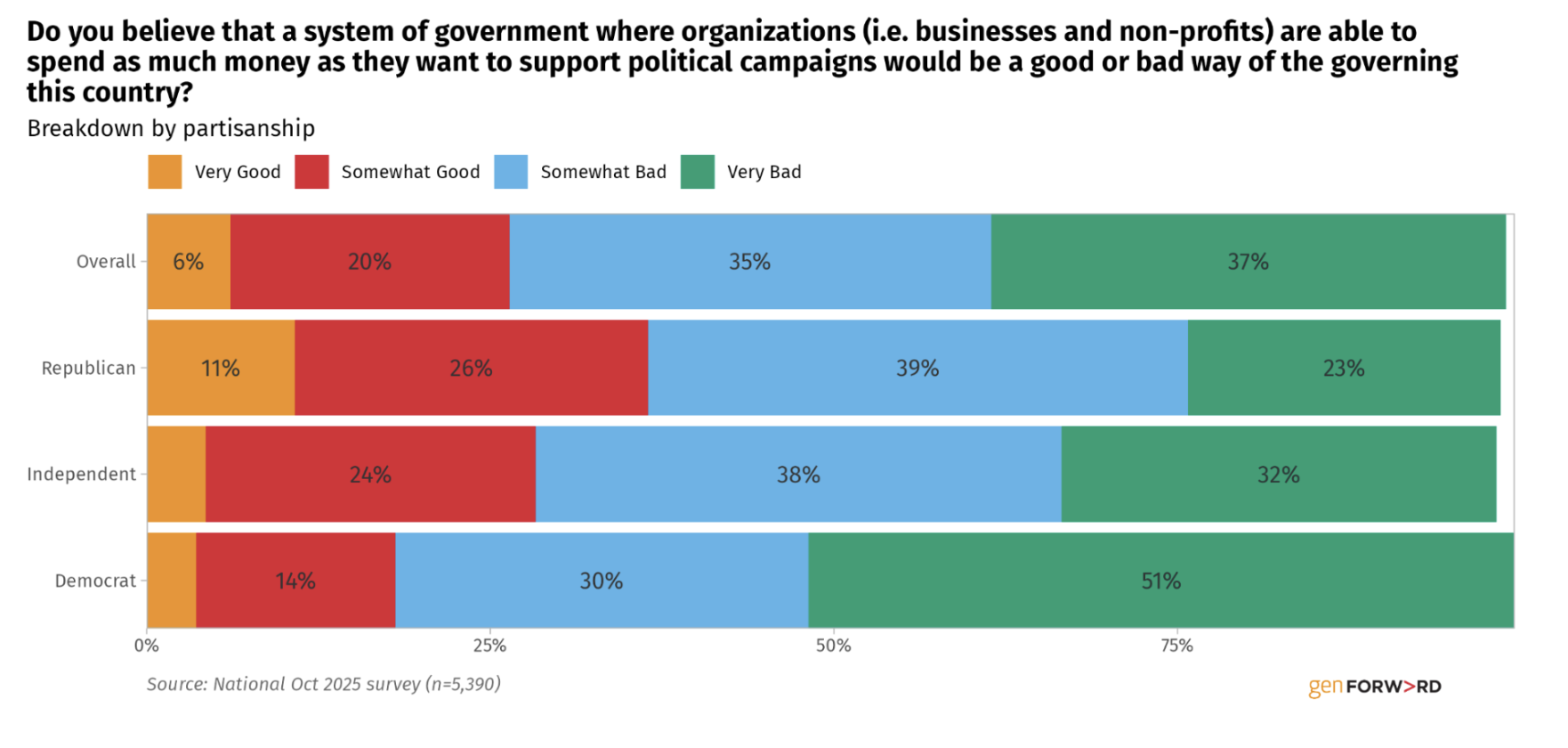
Again, these trends are reflected in our Good Governance Survey data. As demonstrated by Figures 4 and 5, 72 percent of respondents characterized a governmental system in which organizations such as businesses and non-profits are able to spend as much money as they want to support political campaigns as a somewhat or very bad way of governing the country. While a majority of respondents across racial, ethnic, and partisan lines shared this view, concerns were particularly pronounced among white respondents (79 percent) and Democrats (81 percent).
Figure 4
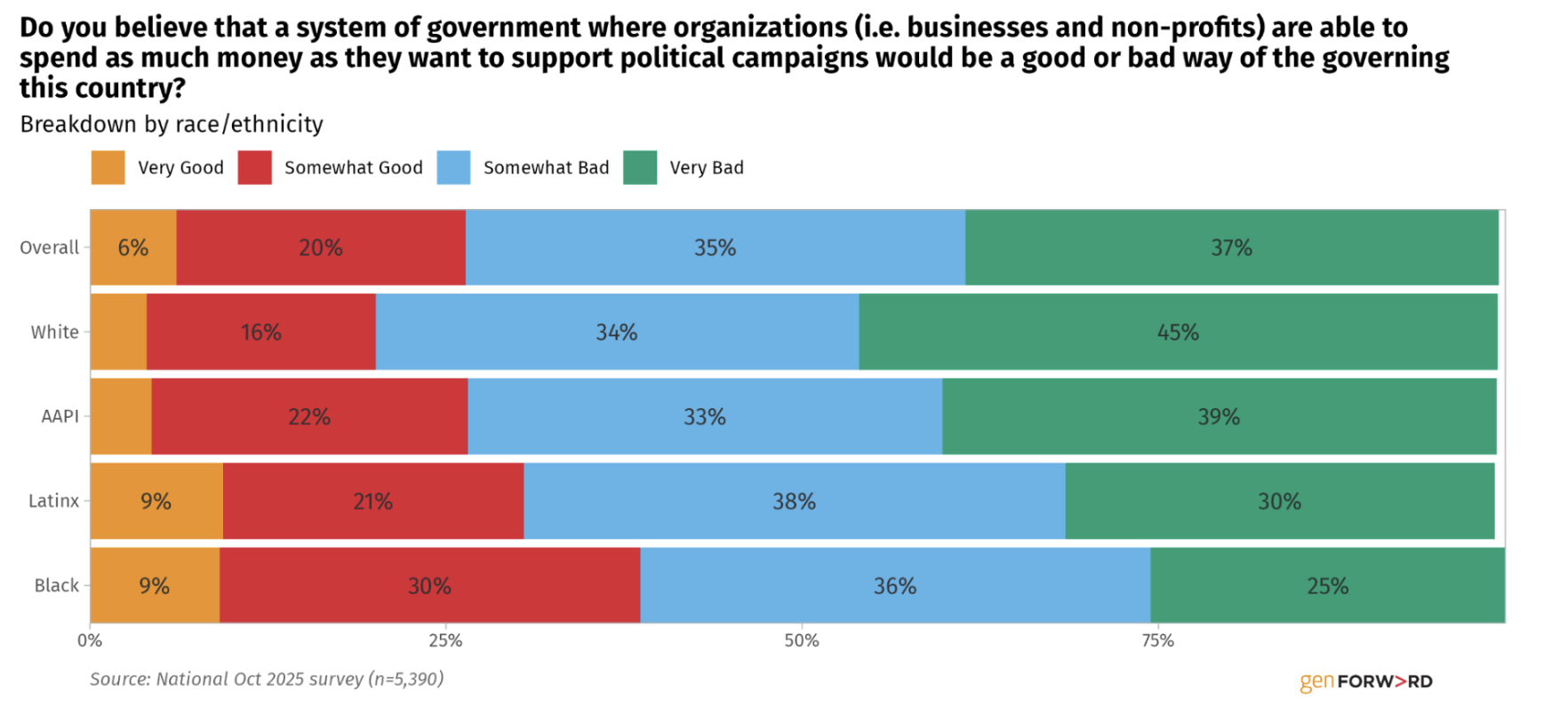
Figure 5
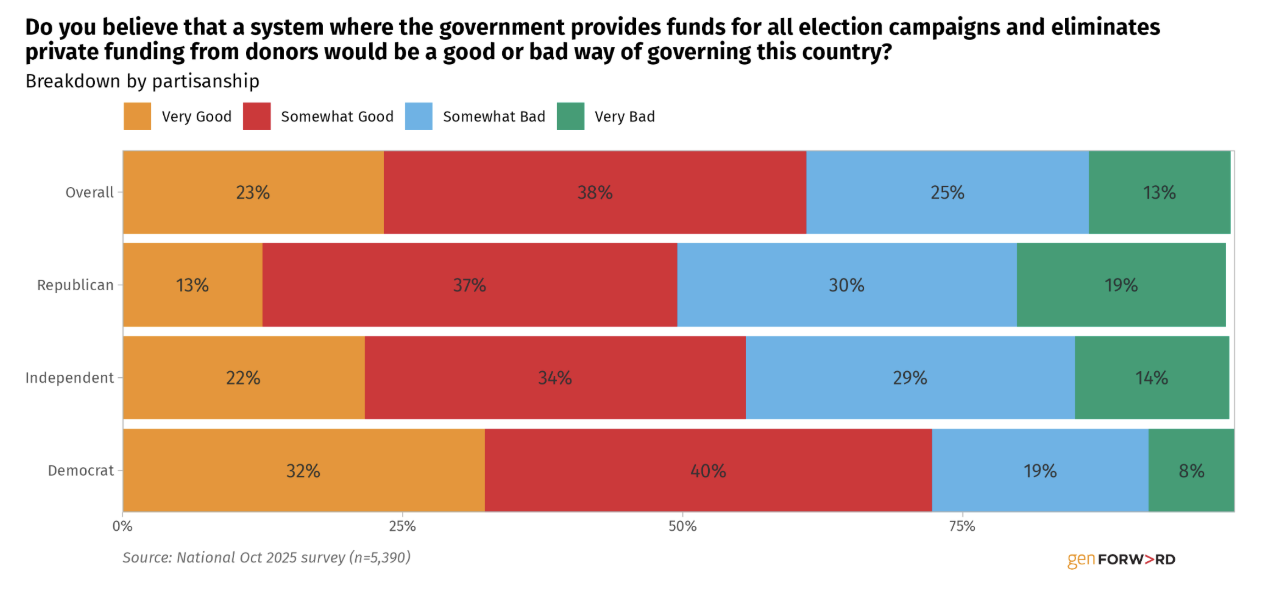
Contrastingly, the survey data summarized in Figures 6 and 7 highlight strong support for a system in which the government provides funds for election campaigns and eliminates private funding from donors. Overall, 61 percent of the young adults included in our survey reported that such a system would be a somewhat or very good way of governing the country. Support for this system was also stronger than one in which individuals can spend as much as they want to support campaigns. Asian American and Pacific Island respondents (66 percent) along with Democrats (72 percent) were the most supportive of this government-funded campaign finance system while Republicans (50 percent) were more skeptical.
Figure 6
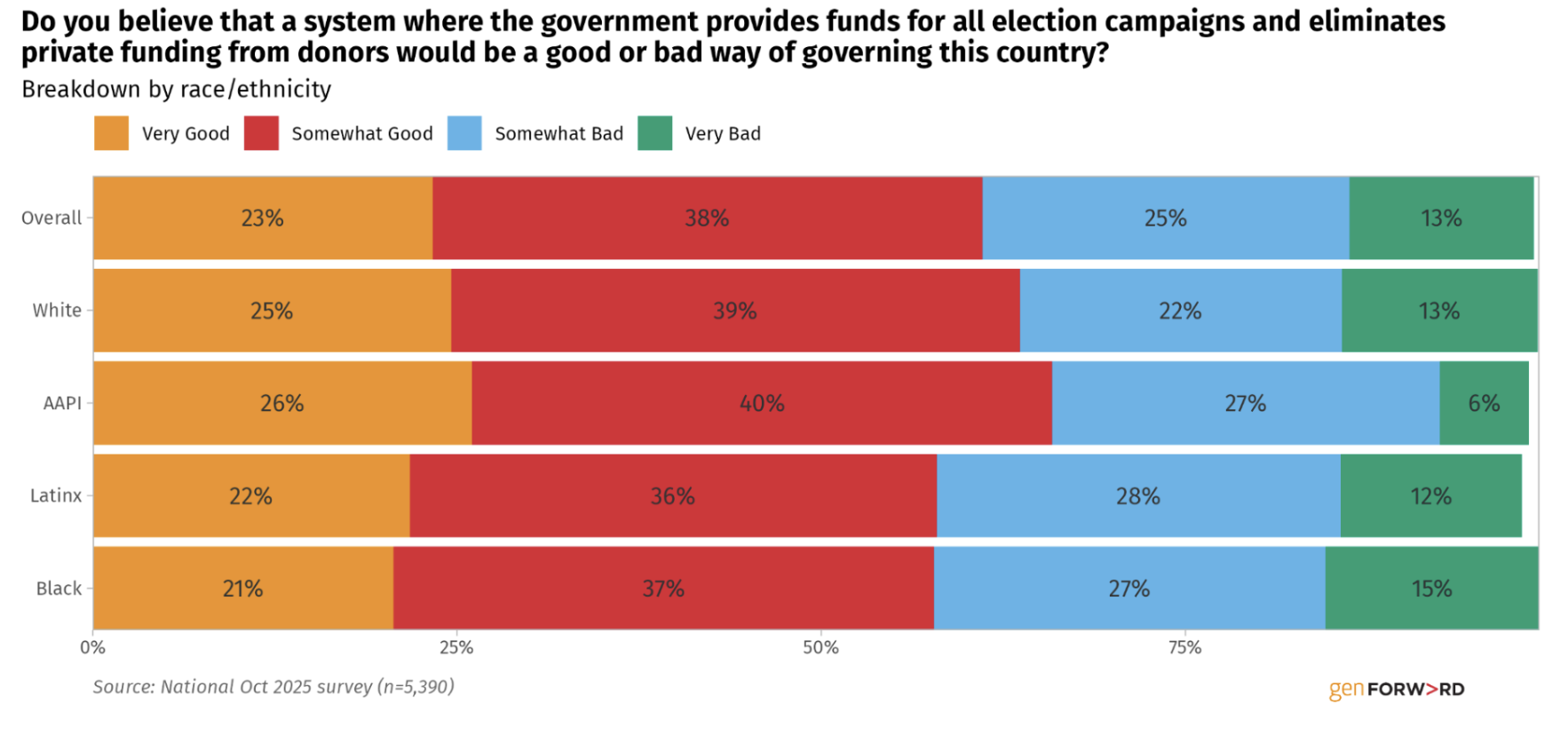
Figure 7
Finally, our focus group participants frequently noted that placing term limits and age restrictions on elected officials would bring about much needed change within American democracy. While the U.S. Constitution does not impose term limits on members of Congress, it does place a two-term limit on serving as president and specifies age minimums for representatives, senators, and the president. James, a 29-year-old white Independent from Ohio, shared the following: “I think you need term limits, especially for members of Congress. You know… regardless of whatever your political stance is, it’s insane to me that my congressman has been in Congress for 20 years.” When describing the benefits of age limits, Ethan—a 34-year-old AAPI resident of Minnesota— stated that “a lot of fresh faces in Congress would be something that would be good for the country.”
For many Americans, the 250th Anniversary of the founding of the United States is far from celebratory. This is perhaps due to a growing sense of disillusionment with a system of government characterized by unchecked, authoritarian-like executive power and the implosion of bipartisan efforts to address pressing affordability issues. While young adults may believe that democracy is preferable to other systems of government, they also see the democratic system practiced in the United States in need of significant reforms. For these young people, electing presidents via popular vote, enacting ranked choice voting systems, removing outside money from politics, and enacting term and age limits on elected officials, offer some initial ways of reimagining what the practice of American democracy should look like 250 years after the founding.
Matt Nelsen (He/Him) is an associate professor within the Department of Political Science at the University of Miami. His work examines how local-level institutions, especially schools and neighborhoods, act as microcosms of democracy and has been featured within Perspectives on Politics, Political Behavior, The Journal of Race, Ethnicity, and Politics, Psychological Inquiry, and the Washington Post.