By Alyssa Sutherland
September 28, 2026
For years, the national conversation about policing has been centered on crime and public safety. We ask whether policing makes communities safer; we rarely ask what it does to the bodies of the people being policed. But a growing body of research within the public health field insists that policing is a tangible public health issue. In 2018, the American Public Health Association, the country’s largest public health organization, formally named law enforcement violence a public health problem, pointing to the deaths, injuries, trauma, and stress that policing distributes unevenly across racialized communities. More than 300 Black Americans are killed by police each year, and at the end of 2023, an estimated 1.77 million Black adults were incarcerated or on probation or parole. For the communities left behind, the harm does not end with the people directly involved.
That reframing matters most for those who carry the heaviest exposure. In the months after the killing of Tyre Nichols, GenForward, in partnership with the Movement for Black Lives, surveyed a nationally representative sample of 3,430 Black adults about their experiences with policing and incarceration and their visions for community safety. The data highlight how policing may impact the health of Black Americans. For young Black adults in particular, exposure to policing and incarceration is not an occasional event, but an ambient feature of daily life. This is a self-reinforcing system that dismantles the psychological and physiological safety of Black communities, and the chronic stress it produces carries measurable public health costs.
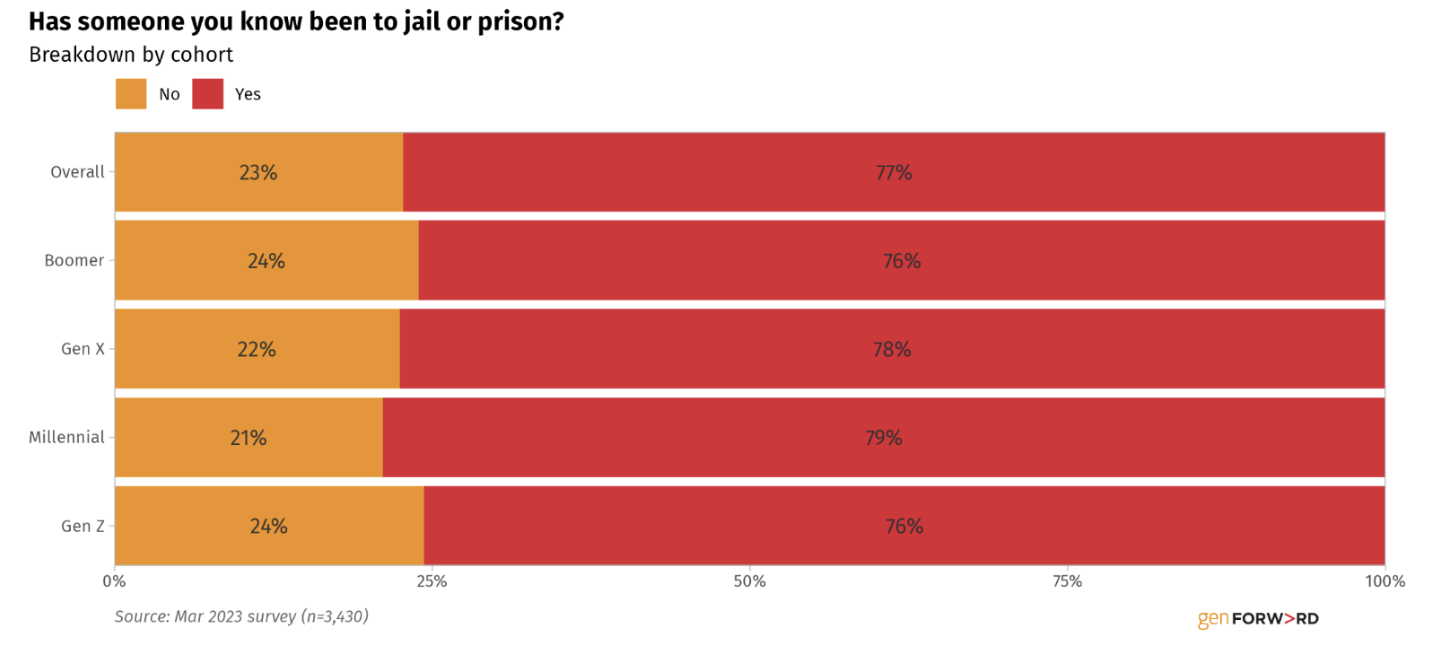
For most young Black adults, the criminal-legal system exists as an omnipresent threat, felt through their own networks and through the images of Black people harmed by police that move across the news and social media. That connection may be personal (someone they know) or racial (a stranger who shares their race). Either way, Blackness knows policing intimately. Notably, while relatively few Black respondents in our sample reported having personally been in jail or prison (18%)—a figure that is low relative to Black communities overall—knowing someone who has been incarcerated is quite common: 77 percent said someone they know has been in jail or prison.For Black Americans across generational groups, the reach of incarceration is felt less through their own incarceration than through the steady accumulation of incarcerated family members, friends, and neighbors. It is not an isolated hardship but a widely shared exposure with population-level and life-course implications.
Figure 1
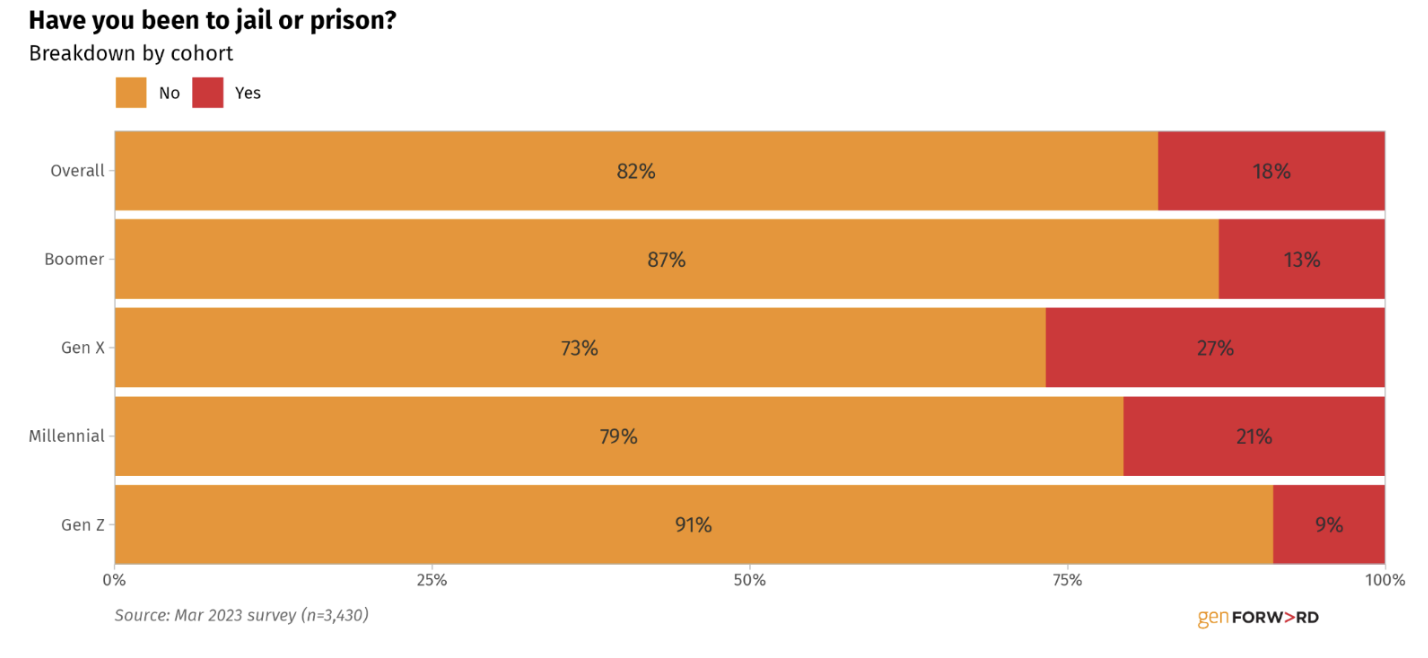
Figure 2
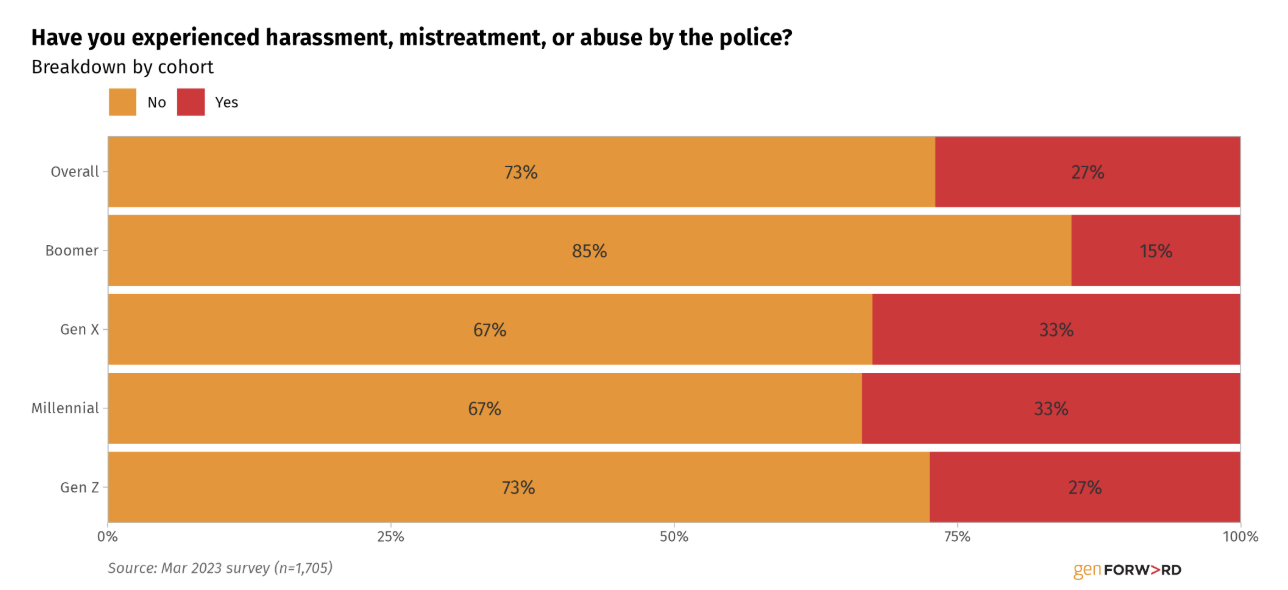
Direct experience of police harassment, mistreatment, and abuse is also common. Roughly one in four Black adults (27 percent) reported personally experiencing harassment, mistreatment, or abuse at the hands of the police, including 27 percent of Black GenZs and 33 percent of Black Millennials.
Figure 3
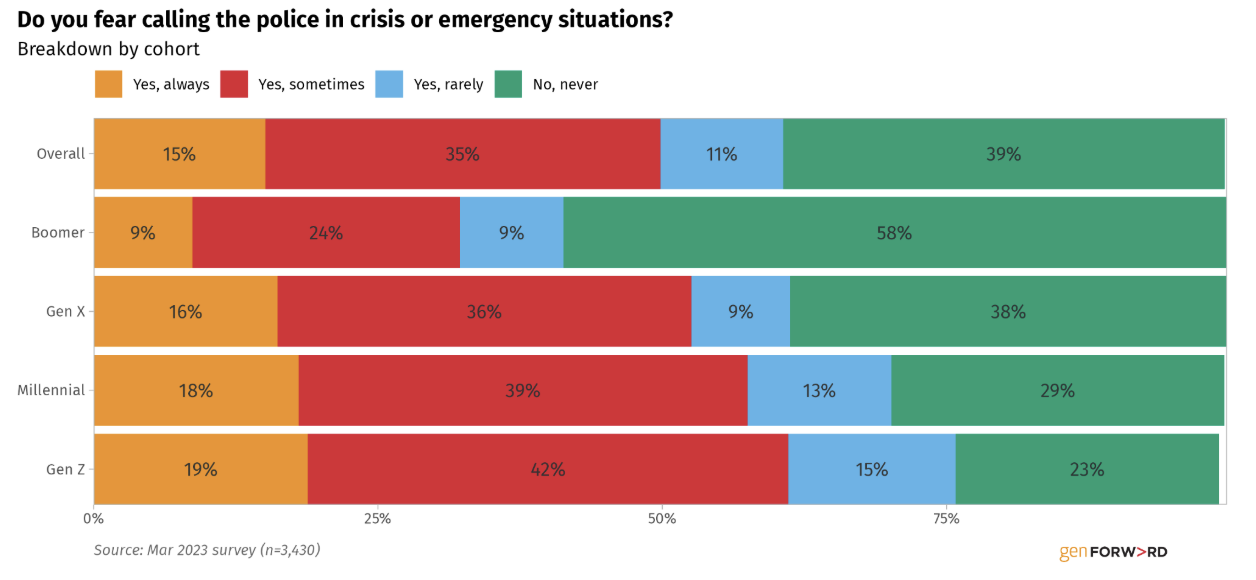
What may matter most for health, however, is not only what has already happened, but what young Black adults anticipate. What connects that anticipation to the body is a mechanism scholars call weathering, or the idea that sustained exposure to social adversity accelerates biological wear, eroding health well before old age. This is a cumulative process where the body’s stress response is activated repeatedly and rarely allowed to stand down. The resulting “allostatic load” registers in (high) blood pressure, inflammation, cardiac stress, and mental health. Crucially, this response is triggered not only by direct harm but by the anticipation of it. Living in a state of vigilance, bracing for a negative encounter that may or may not come, is itself a physiological burden.
When participants were asked whether they fear calling the police in a crisis or emergency, the youngest respondents were the most afraid: 61 percent of Black Gen Zers and 57 percent of Millennials reported fearing it always or sometimes, compared with just 33 percent of Boomers. Their responses capture this idea of a sustained state of worry and a bracing against the very system meant to provide help. It is that ongoing, anticipatory stress, more than any single incident, that links these experiences to the body. The exposures documented above are, in this light, not merely one-off experiences young Black adults have had, but they are ongoing conditions their bodies are processing.
Figure 4
Notably, Black Americans themselves already understand their circumstances in these terms. Asked whether the killing of Black people by the police threatens the ability to build healthy and thriving Black families, 77 percent of the Black respondents either strongly or somewhat agreed. Agreement was high and consistent across every generation, from 73 percent of Gen Z to 80 percent of Gen X. Asked whether it feels safe to raise Black children today, a majority (53 percent) either strongly or somewhat disagreed that it feels safe to raise Black children. Interestingly, Black Gen Zers were the only generational cohort in our sample where less than half (39 percent) either strongly or somewhat disagreed with this sentiment.
Figure 5
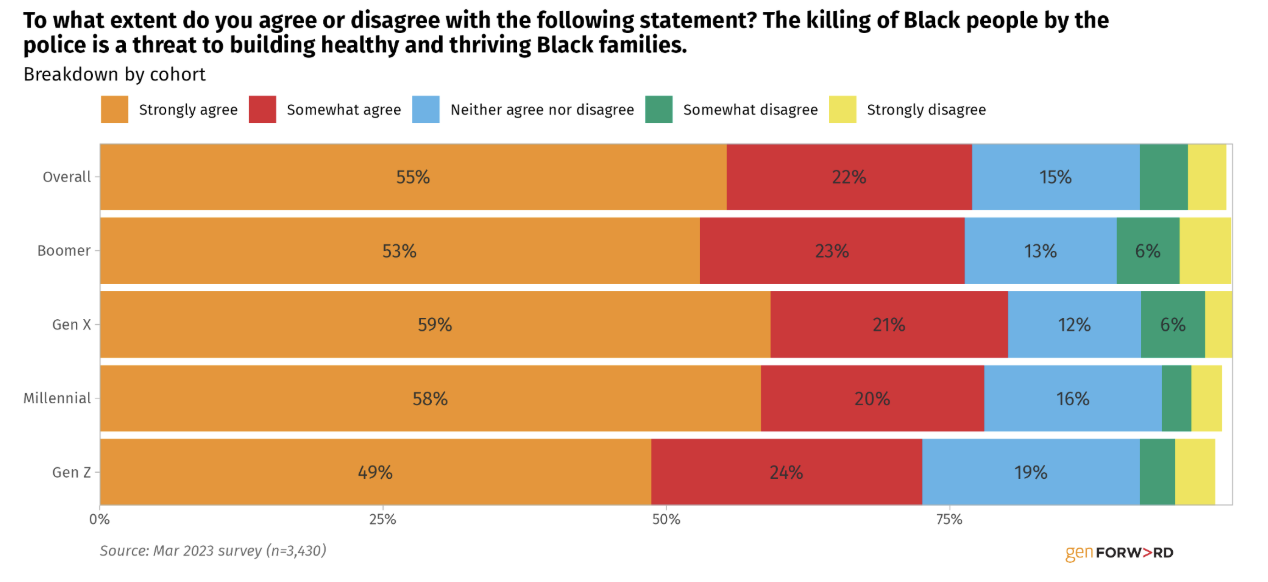
Figure 6
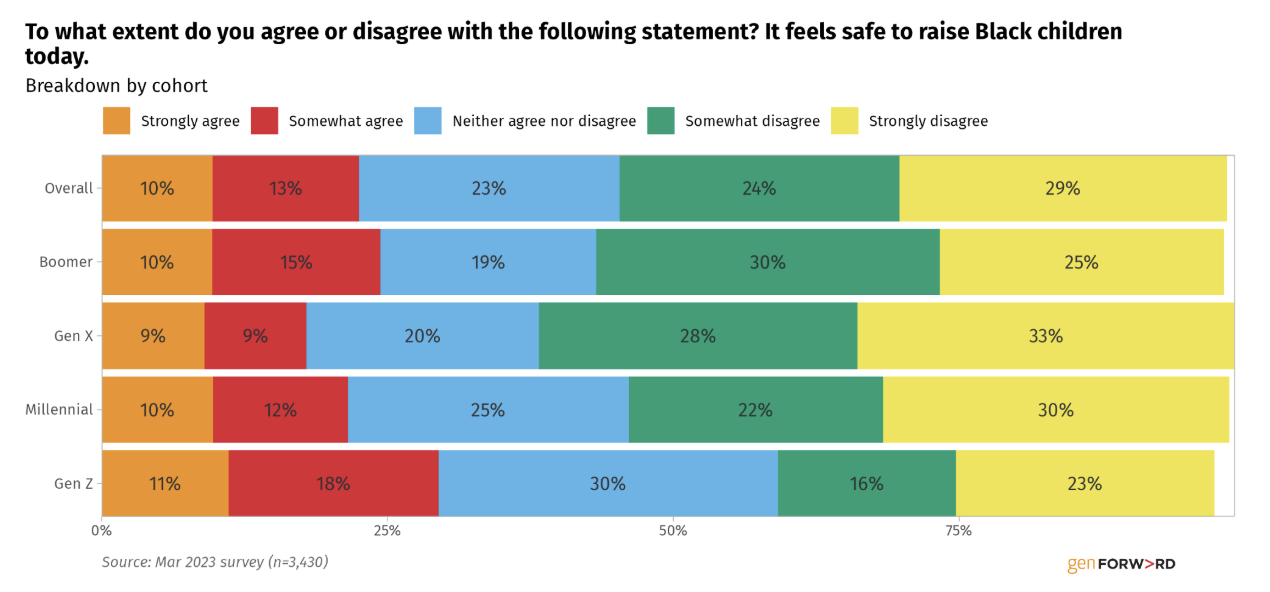
Black Americans’ sense that it doesn’t feel safe to raise Black children is supported by existing public health research. The research shows that living with this kind of chronic fear does real damage to the body. The survey captures what Black adults sense about their world, and the science confirms that what they sense is taking a measurable toll on their health.
Framed this way, the fear of calling the police during a crisis is not only a statement about trust in an institution. It is a description of a population that may hesitate to seek help in exactly the moments help is most needed, a downstream health cost beyond the stress itself. It is also why so many of the young Black adults in this survey expressed support for non-police alternatives such as trained crisis responders: they are describing the conditions under which they could feel safe reaching for care.
We must begin treating policing as the public health issue that the field of public health urges. The data here cannot, on their own, prove that policing shortens Black lives. But they do document how the stress of policing and incarceration saturates the everyday lives of young Black adults, and a growing evidence base tells us what sustained exposure to the carceral state does to a body over time. For the generations already carrying this weight, the health costs are not hypothetical. They have been accumulating. The question is, what are we going to do about it?
Alyssa Sutherland (She/Her) is a communications and editorial specialist and public health researcher based in New York City. She is a Master of Public Health candidate at Columbia University’s Mailman School of Public Health in the Department of Population and Family Health, where her work centers on sexual and reproductive health, gender, human rights, and public health communications. She holds a B.S. in Public Health and Women’s and Gender Studies from Syracuse University. Her research interests include reproductive justice, gender and sexuality, digital storytelling, community-rooted research, and the politics of health communication. As a Black feminist storyteller, her praxis merges strategic communications with public health to create impact, centering community voice and lived experience. A St. Louis native, she has conducted qualitative research on disability, gender, and race in India as a research fellow at the Jagori Rural Charitable Trust. She was named a John R. Lewis CDC Scholar in 2023 and received the Public Health Social Justice Award from the Maxwell School of Citizenship and Public Affairs at Syracuse University in 2025. She also serves as a Community Engagement and Digital Storytelling Fellow at the Lerner Center for Public Health Promotion and as a Graduate Teaching Assistant for Qualitative Data Analysis at Columbia.