By Diane Wong
August 25, 2026
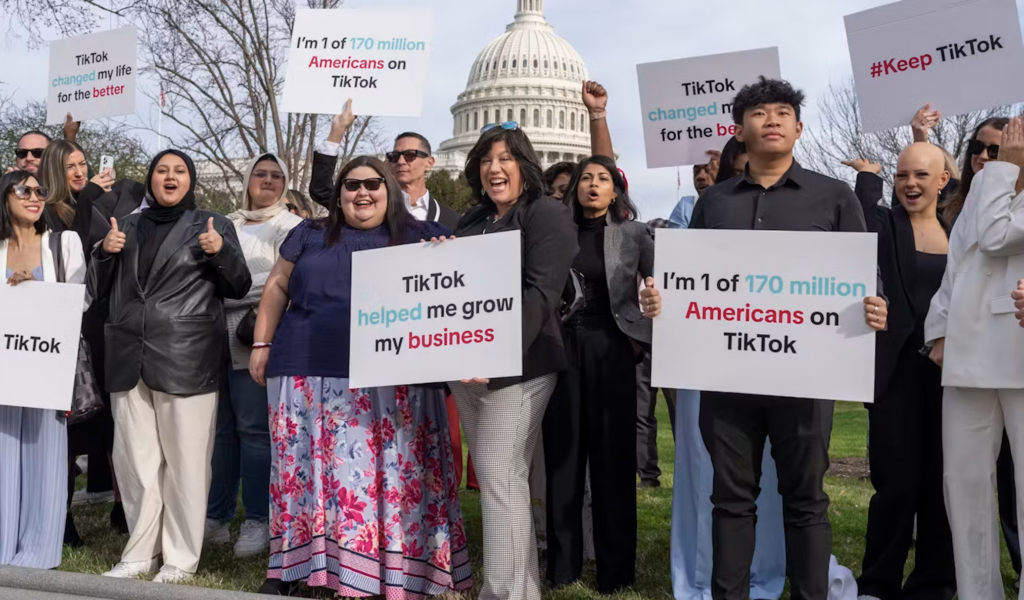
For years, lawmakers have debated whether TikTok should be banned in the United States. Much of this debate has centered on national security, data privacy, and geopolitical risks associated with the platform’s Chinese ownership. Yet after years of proposed bans and legal challenges in Congress, the courts, and the White House, TikTok remains deeply embedded in the everyday lives of young Americans and how they understand politics.
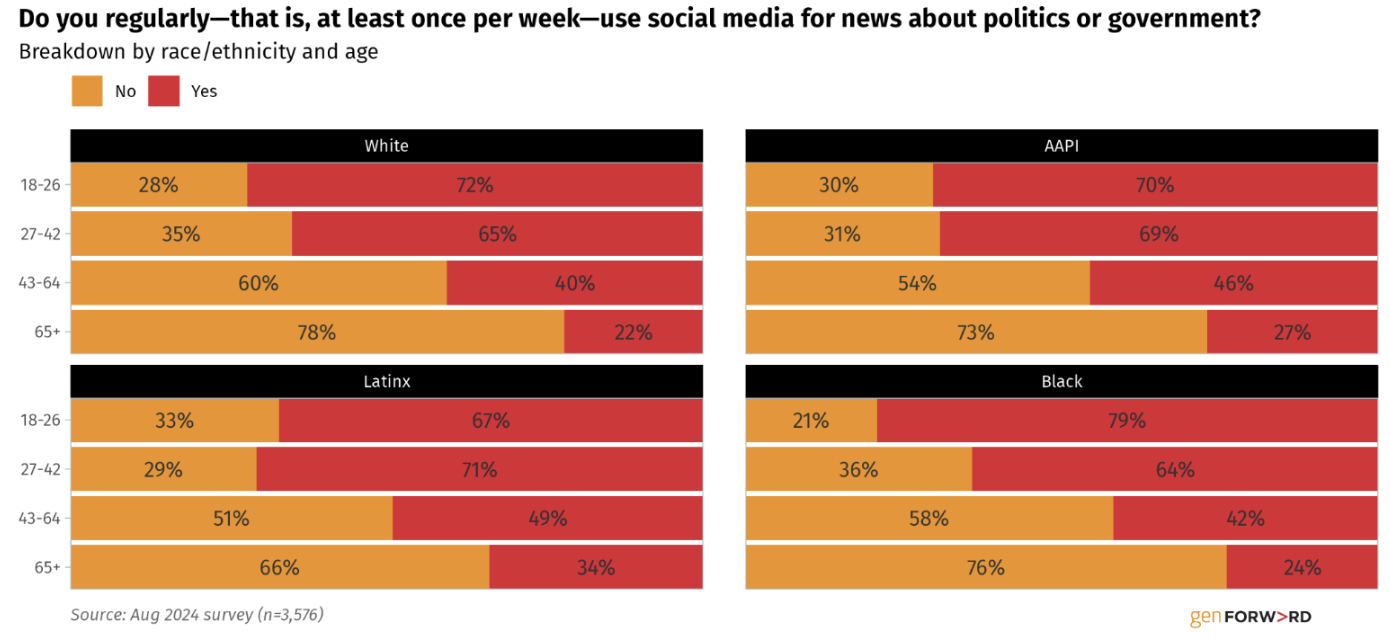
This shift towards social media is part of a broader transformation in how young people receive political information. According to the August 2024 GenForward survey, which surveyed people from across generational groups, 79 percent of Black respondents aged 18-26 used social media for news about politics or government at least once a week, alongside 72 percent of white, 70 percent of Asian American Pacific Islander (AAPI), and 67 percent of Latinx respondents in the same age group. While Latinx respondents ages 27-42 were slightly more likely than their younger counterparts to regularly use social media for news about politics, the broader pattern shows that younger respondents were far more reliant on social media for political news than older generations, especially when compared with those over 65.
Figure 1
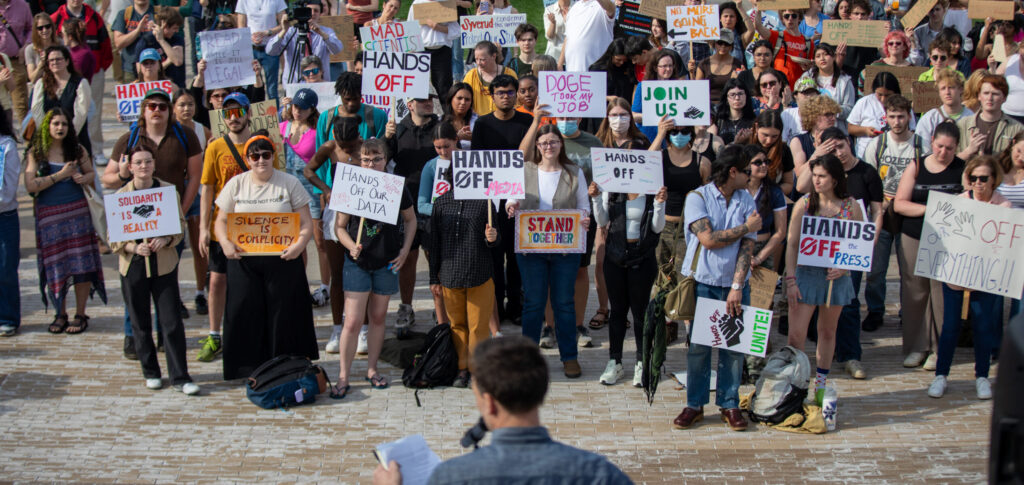
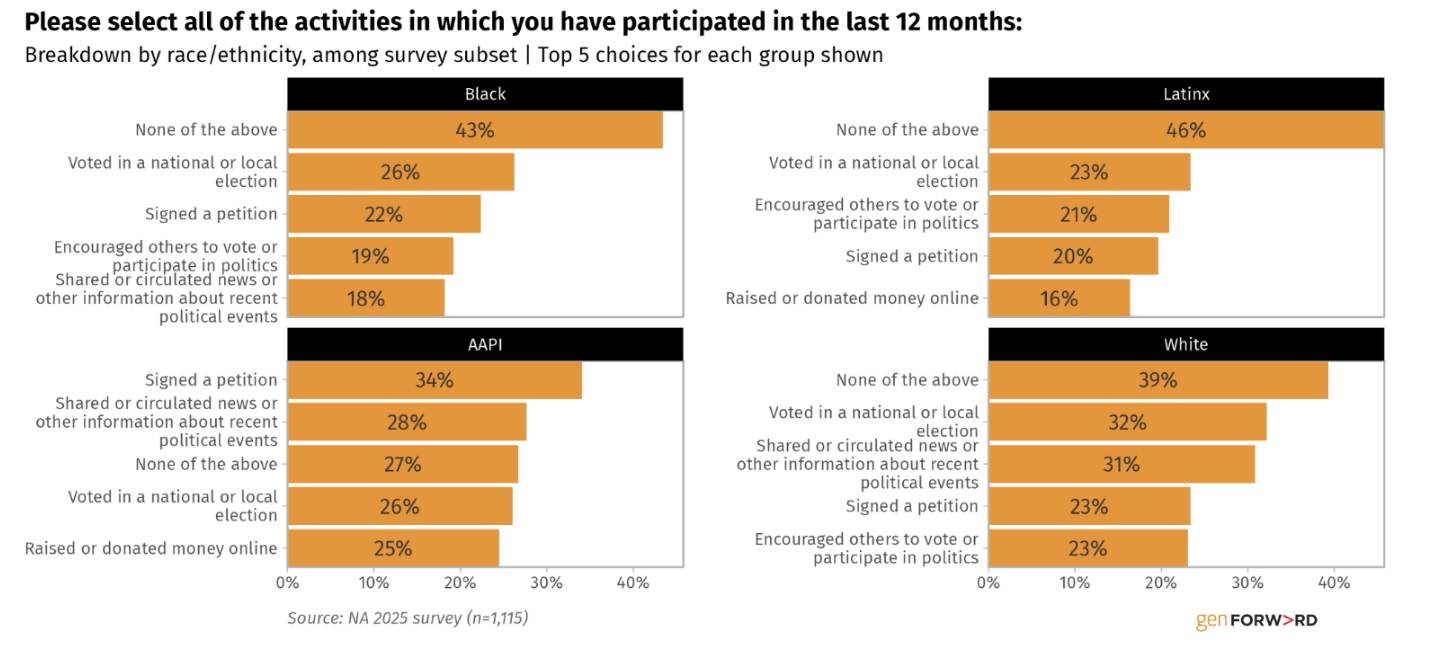
Importantly, young people are not passive recipients of news on social media but actively circulate information through their own networks. Data from our 2025 Good Governance Survey indicated that among respondents 18-26, 31 percent of white, 28 percent of AAPI, 18 percent of Black, and 14 percent of Latinx young adults reported sharing or circulating news or information about recent political events. These sizable racial differences complicate narratives of a singular political experience and point to meaningful variation in how young adults participate in political life. In addition, 4 percent of Black, 16 percent of Latinx, 25 percent of AAPI, and 5 percent of white respondents aged 18-26 shared that they had raised or donated money online. Social media platforms like Tiktok now enable multiple nodes of engagement, allowing users to move between watching, commenting, sharing, donating funds, and circulating links across networks.
Figure 2
Data from Pew Research show that nearly 43 percent of Americans ages 18 to 29 now regularly get news from TikTok, up from only 9% in 2020. TikTok’s role as a source of political news also varies across racial groups, with 36% of Latinx young adults and 30% of Black young adults who report regularly getting news on social media compared with 17% of AAPI and 14% of white young adults. Black and Latinx teens are also more likely than white teens to use social media and to report using the platform almost constantly. These patterns suggest that the platform occupies a particularly important place in the political information environment for young people of color.
Young people do not necessarily go on social media looking for discussions about politics. Political information is often encountered incidentally, interspersed with the entertainment and everyday lifestyle content that initially bring users to the platform. You might open TikTok to watch a funny reaction video, only to find yourself three swipes later watching someone explaining an ICE raid. Another swipe brings a creator reacting to the Cyclosporasis outbreak, followed by someone talking about disability justice or immigration detention at Delaney Hall, and then you are back to watching travel recommendations or recipe content.
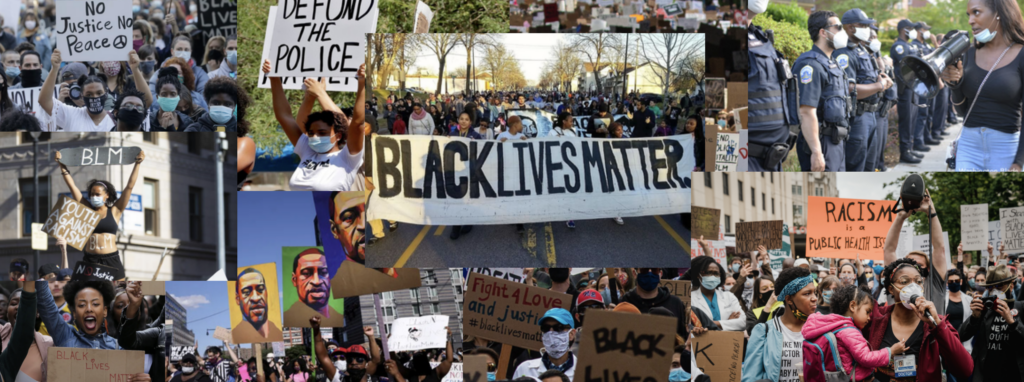
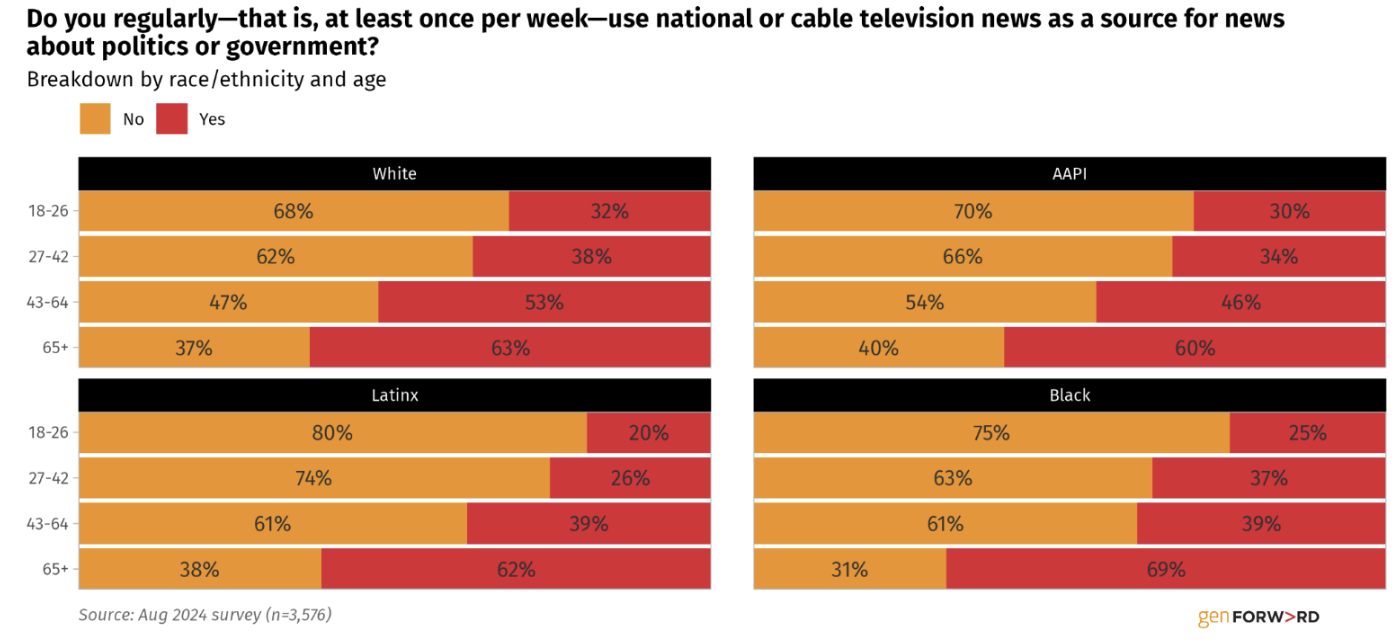
The platform helps shape what political issues receive attention and can function as a digital counterpublic, allowing marginalized communities to circulate interpretations of political events outside of traditional media. Social media can also make issues that have historically received little attention in mainstream political discourse more visible, from anti-Asian violence and police encounters to protests over Gaza. GenForward data from August 2024 show that young adults are consistently less likely than older generations to rely on traditional news sources. Across racial and ethnic groups, 18-26-year-olds were the least likely to rely on television news. Among Black respondents, for example, only 25 percent reported using cable or national news at least weekly, compared with 69 percent of those over 65, while the figure among young Latinx respondents was even lower at only 20 percent.
Figure 3
While social media has democratized access to political information, advocates have warned that this visibility is not neutral. What distinguishes platforms like TikTok from other social media is its algorithm, which curates what users see and how they encounter information through a personalized “For You” feed. By learning from users’ behavior, the algorithm determines which issues become visible, which voices gain traction, and which videos users encounter repeatedly. TikTok concentrates significant power to observe and shape young people’s political attention, while simultaneously collecting records about their interactions, interests, and networks. This raises questions about surveillance and autonomy that extend beyond debates over the platform’s ownership.
Respondents included within a series of eight focus groups conducted by GenForward in April of 2026 expressed concerns about how social media algorithms shape perceptions of reality. Christine—a 42-year-old, AAPI, Democratic woman from Illinois— shared, “I have deep concerns about the influence and power of the media at this point in shaping what truth and what version of history and what version of the present people are engaging with. Social media in particular, really concerns me, and the extent to which algorithms are shaping what versions of humanity you see.” These concerns extend to how social media has complicated people’s ability to determine what information they can trust. Amy—a 34-year-old, White Republican woman from Michigan— explained, “It’s also really hard to know what’s true and what’s not true with social media and things that are being posted, sometimes exaggerated and with AI you just never know what to believe.”
Other focus group participants raised concerns about how social media algorithms can deepen political polarization. Nathan—a 25-year-old, AAPI, Republican leaning man from Illinois— reflected on the dangers of TikTok’s algorithm in narrowing the range of perspectives users encounter, “If you watch too much left wing content, you’re just gonna see the same people, right? If you try to watch right wing content, your mind is gonna be right. People gonna be so divided and they cannot speak in the same language.” Interestingly, these concerns about online echo chambers have also pushed some young people to look beyond social media and to participate more fully in their local communities. As Noah—a 26-year-old, AAPI, transgender, Democratic leaner from Illinois— shared, “I agree with not staying in these echo chambers that are largely fueled by social media. The reason I feel so obligated to be involved in my local community is because a lot of the things I do for my community are things the government doesn’t offer as social services.”
These concerns are particularly salient for activists and communities of color with long histories of state surveillance and political repression. The same digital platforms that allow individuals to organize protests, document immigration raids, and circulate political information can also create new vulnerabilities for the communities that use them. This is precisely why community activists and movement-based technologists have experimented with alternative platforms like Unscrolled, designed around greater community control and data security. Rather than wait on governments to hold major technology companies accountable, communities are already finding ways to build the infrastructure to participate politically without surrendering control over their data.
Diane Wong (She/Her) is an Assistant Professor in the Department of Political Science at Rutgers University, Newark. She holds a Ph.D. in American Politics and M.A. in Comparative Race, Ethnicity, and Immigration from the Department of Government at Cornell University. Her interests include American politics, Asian American activism, gender and sexuality, urban governance, comparative immigration, cultural and media studies, and community rooted research. Born and raised in Flushing, Queens in New York City, her research is intimately tied to the Asian diaspora and urban immigrant experience. Her work has appeared in PS: Political Science and Politics, Urban Affairs Review, Women’s Studies Quarterly, Amerasia Journal, Frontiers, and a variety of edited book volumes, journals, anthologies, podcasts, and exhibitions. She is author of Asian America Rising: New Directions for Political Activism (NYU Press, 2025) and You Can’t Evict A Movement: Housing Justice and Abolitionist Futures in New York City (Penn Press, 2026). Diane is a socially engaged artist and organizer, her latest exhibits include “Degentrification Archives” at Pace University Art Galleries and “Archive as Memorial” at Storefront for Ideas in New York City.