By Matt Nelsen
November 2, 2026
With campaign spending projected to reach $11.6 billion by Election Day, 2026 is slated to become the most expensive midterm election cycle on record. While financial resources let candidates flood the airwaves and social media feeds with campaign advertisements, cash alone—as Hillary Clinton, Kamala Harris, and Elon Musk can attest—won’t guarantee electoral success. Yet, in the days leading up to this week’s midterm elections, media outlets have reported extensively on the contributions of wealthy donors, including $474 million for Republican candidates from Elon Musk since July and an eleventh-hour $80 million donation for Democrats from Michael Bloomberg. Similarly, AIPAC—The American Israel Public Affairs Committee— announced that it would donate up to $8 million to Republican Senate candidate Mike Rogers in an attempt to stop his Democratic challenger, Dr. Abdul El-Sayed. This expenditure represents a small fraction of the $233 million raised by AIPAC—and distributed through its United Democracy Project Super PAC— to bolster candidates who support U.S. military spending in Israel while attacking those critical of this policy.
As young adults in the United States grapple with daily affordability concerns and long for a reimagined democracy that responds to the concerns of everyday people, GenForward considers how young Americans view the influx of cash into political campaigns. Overwhelmingly, we find that young people are not only unmoved by this incessant campaign spending, but view it as a key form of corruption shaping contemporary American politics.
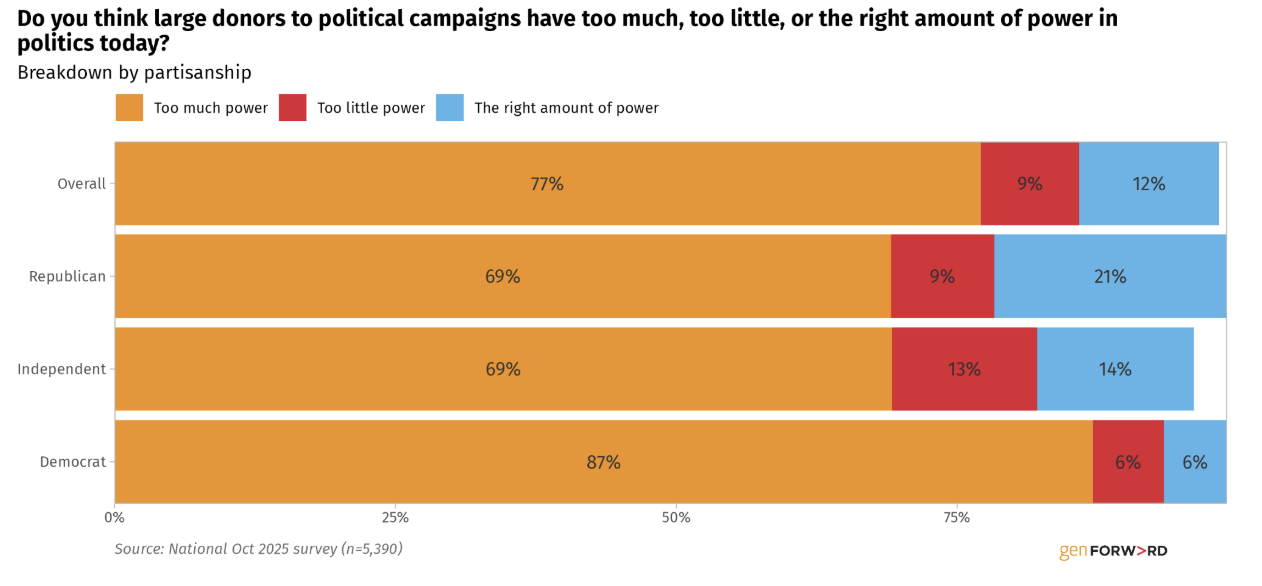
In our November 2025 Good Governance Survey, we asked a national sample of 5,390 young adults (ages 18-42) whether they felt that large donors to political campaigns had too much, too little, or the right amount of power. As demonstrated by Figure 1, an overwhelming 77 percent of young adults included in our sample declared that large donors had too much power. This sentiment was particularly pronounced among white (82 percent) and Asian American Pacific Isalnder (80 percent) young adults. Examining these results by partisanship, Figure 2 shows that young Democrats (87 percent) were more likely to say that large donors had too much power in politics today. However, large majorities of both young Independents (69 percent) and Republicans (69 percent) also reported that large donors had too much power.
Figure 1
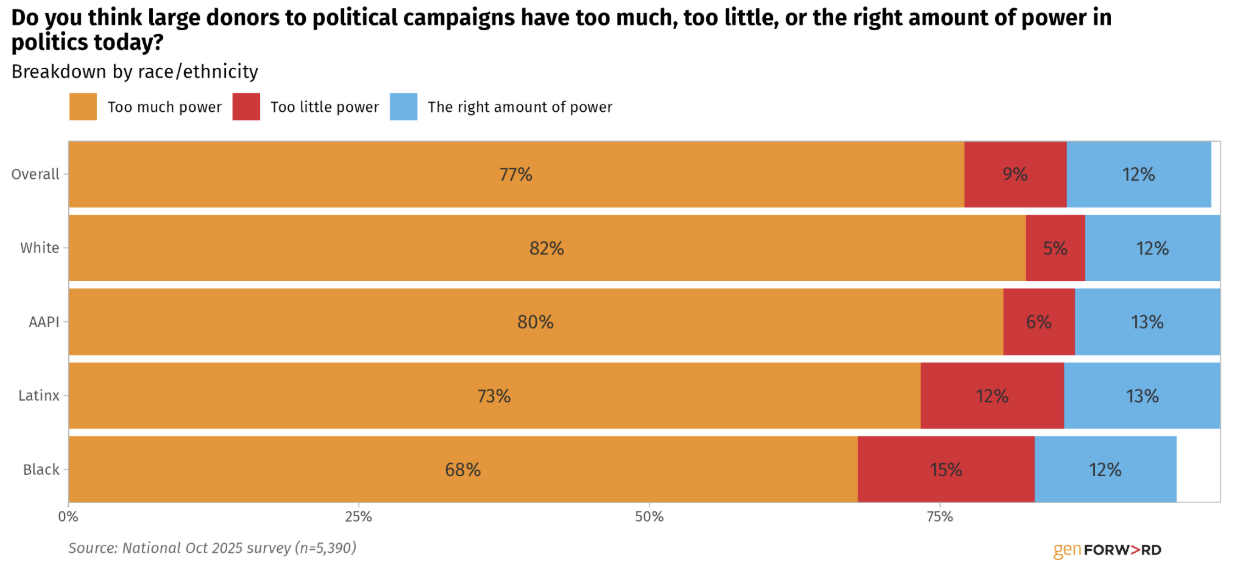
Figure 2
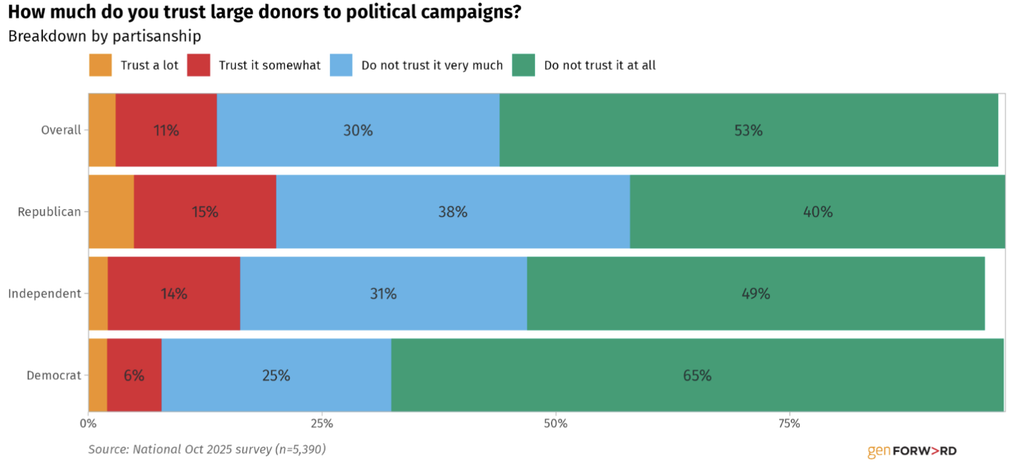
We also asked the young adults included in our sample whether they trust these large campaign donors. As Figure 3 shows, 83 percent of respondents reported that they do not trust these donors very much or at all. This sentiment was most pronounced again among white (87 percent) and Asian American Pacific Islander (82 percent) young adults. When we examine these results by partisanship in Figure 4, we find that 90 percent of young Democrats, 80 percent of young Independents, and 78 percent of young Republicans do not trust these donors very much or at all. Thus, even in a political climate marked by record rates of partisan polarization, a deep distrust of large campaign donors emerges as a unique point of consensus, at least among young adults.
Figure 3
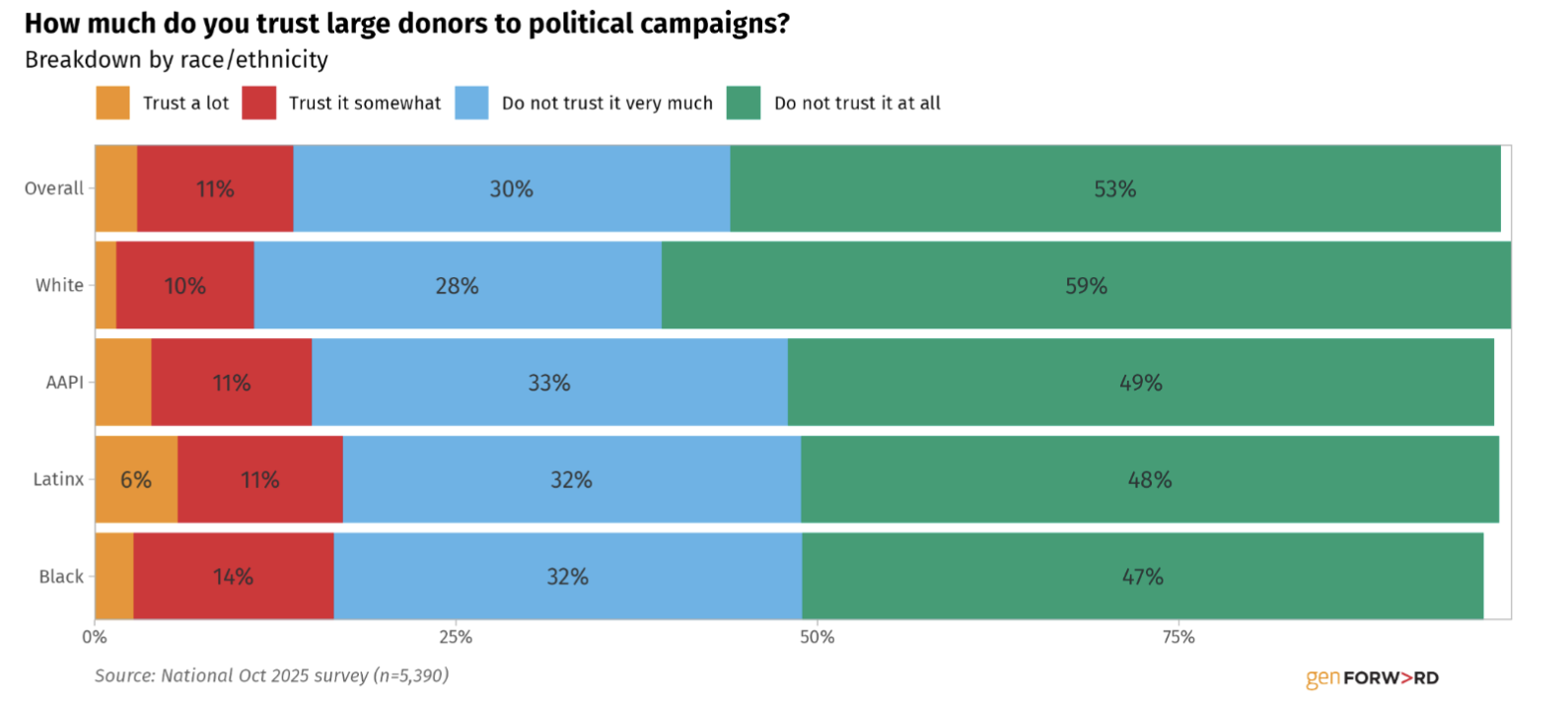
Figure 4
Similar distrust and disdain for large donors also was articulated within a series of focus groups conducted by the GenForward research team in April 2026. This research consisted of eight focus groups, comprised of 94 young adults living in six Midwestern states–Ohio, Michigan, Wisconsin, Minnesota, Indiana and Illinois. The sample included 16 AAPI, 22 Black, 20 Latine, one multiracial, and 35 white young adults ranging in age from 18 to 42. Fifty-three of these individuals identified as Democrat, 19 as Independent, and 22 as Republican. The focus groups touched on a variety of topics including power and corruption in the United States. While President Trump was the most frequently invoked example of corruption in politics, the young adults we spoke with frequently linked this corruption to wealthy donors as well. For example, Carmen—a 35-year-old, Latina Republican from Illinois noted that “campaign donors…have way too much power. You know, you donate $500 million to a campaign—Elon Musk—and suddenly you get to stand next to the president in the Oval Office and talk over him. It’s absolutely obnoxious.”
Wealthy Democratic donors, including Illinois Governor J.B. Pritzker—another prominent 2026 Democratic donor—were also criticized by the focus group participants. For example, Carolyn—a 35-year-old, Black, Democrat from Illinois—noted that “ Pritzker funded his entire campaign” and that “the people who are rich and getting richer…[those] that have money to spare should be using their resources to fund social programs rather than political campaigns.”
For others, large political donors were not only viewed as corrupt and obnoxious, but something to organize against. Tiffany—a 40-year-old, Black, Democrat from Illinois shared the following: “Rich people love throwing money around just because they feel that they can…This is a game to them…That’s why people need to be informed about what they are going to do…because the billionaires already know what they’re going to do…they already have their mission. It’s about us having a mission now. So to answer your point [about who is corrupt]: Sam Altman, and as others have already put in the chat, Elon Musk, Donald Trump. Basically, we’re looking at Silicon Valley.”
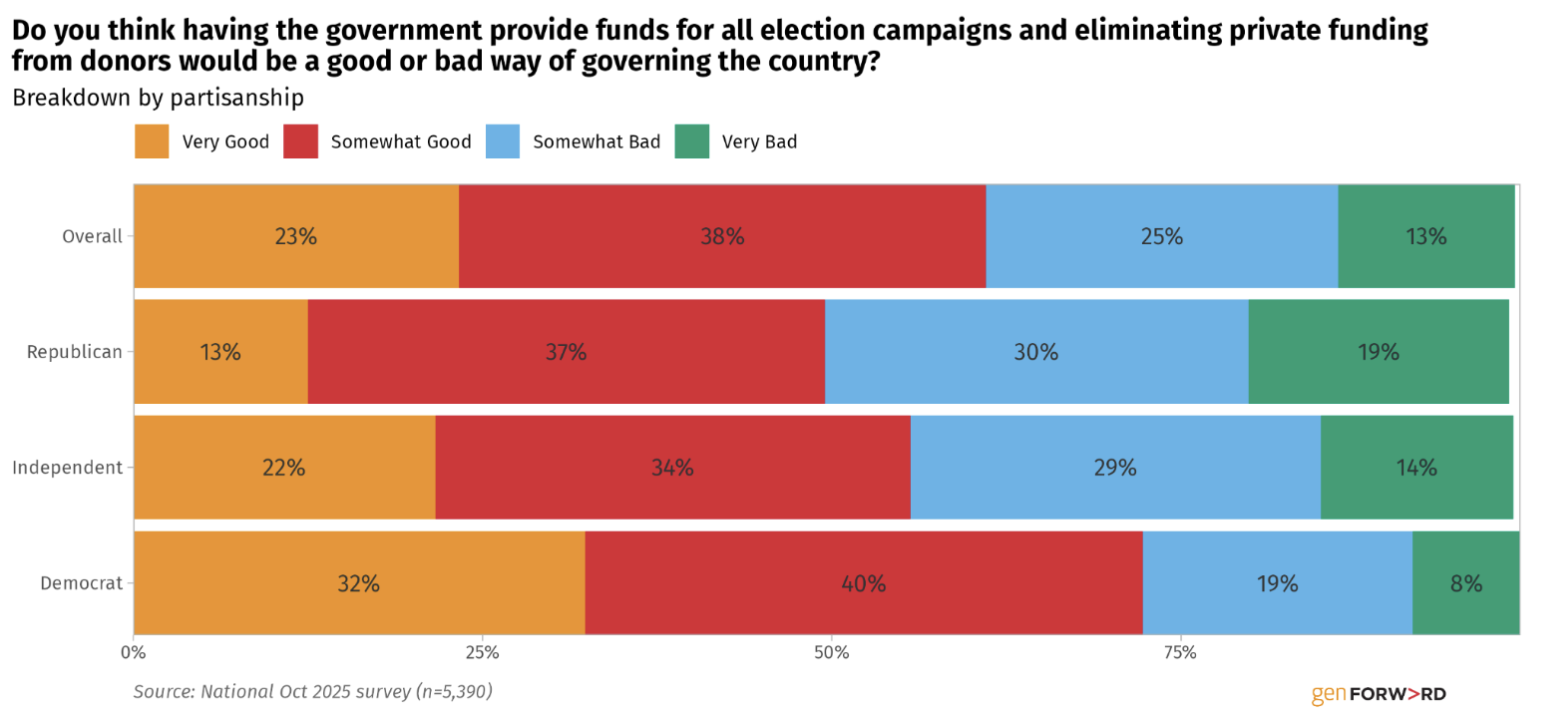
While the young adults included in our survey voiced real anger and frustration related to large donors, they also had clear opinions about possible policy options to address money in politics. In the same November 2025 survey, we asked respondents whether having the government provide funds for all election campaigns and eliminating private funding from donors would be a good or a bad way of governing the country. Figure 5 shows that the majority of the young adults respondents to the survey (61 percent) reported that this was a somewhat or very good idea. This position was particularly pronounced among Asian American Pacific Islander (66 percent) and white (64 percent) young adults. Across partisan lines (see Figure 6), 72 percent of Democrats, 56 percent of Independents, and 50 percent of Republicans felt that eliminating private funding from donors and having the government provide campaign funds would be a somewhat or very good idea.
Figure 5
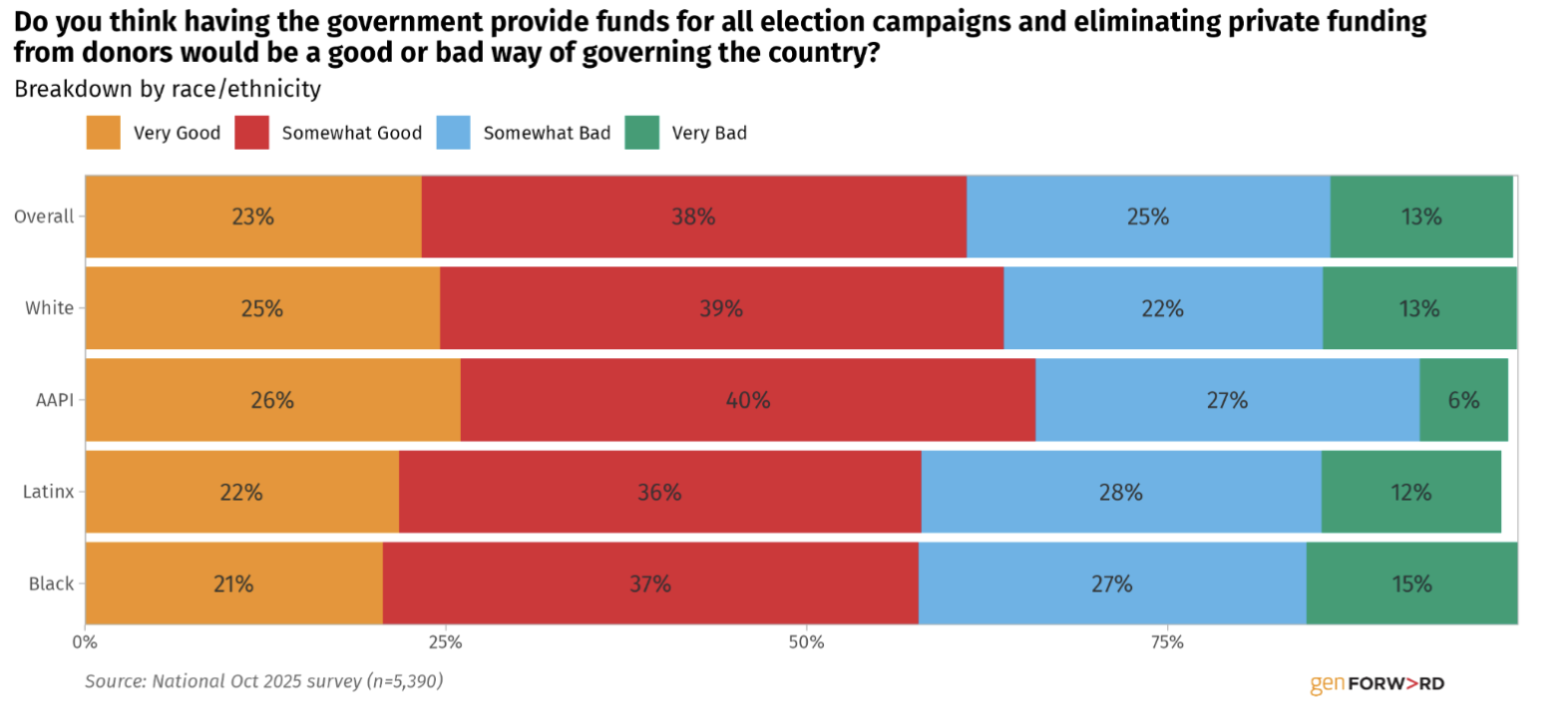
Figure 6
As Election Day approaches, media outlets and political campaigns should consider what the influx of additional campaign funds into an already expensive campaign cycle signals to young voters. Our survey and focus group data suggest that young people across racial, ethnic, and partisan lines view these donors with a great deal of skepticism. Rather than being politically mobilizing, the looming specter of money in politics and the corruption it often facilitates may further intensify young adults’ sense of alienation on the eve of the 2026 midterm elections.
Matt Nelsen (He/Him) is an associate professor within the Department of Political Science at the University of Miami. His work examines how local-level institutions, especially schools and neighborhoods, act as microcosms of democracy and has been featured within Perspectives on Politics, Political Behavior, The Journal of Race, Ethnicity, and Politics, Psychological Inquiry, and the Washington Post.